
Motivation can help a young entrepreneur begin, but it cannot run the business every day. This guide explains how realistic routines, simple records and honest review build customer trust, money discipline and consistent delivery.
The business that keeps restarting
Consider a situation built from common early-stage business patterns.
Mwamba is a final-year student who starts a small design and printing service. During the first week, he is fully committed. He creates a social media page, posts samples, tells his classmates and promises fast delivery. The first few enquiries give him energy. He begins imagining a bigger brand, better equipment and a growing list of customers.
Then ordinary life returns.
Assignments become demanding. Data bundles run low. A customer asks for revisions. One supplier delays. A friend invites him to join a different business idea that looks more exciting. Mwamba stops recording payments, replies late and postpones unfinished work because he no longer feels the same excitement he felt at the beginning.
A month later, he changes the logo, announces a “fresh start” and promises that this time he will be serious.
The problem is not that he lacks ambition. The problem is that he is asking for motivation to do the work of a business system.
The central lesson "Motivation can create movement. Discipline creates reliability. A customer, partner or team cannot build around how inspired the founder happens to feel today". |
Motivation is useful — but it changes
Motivation is the emotional energy that makes an action feel attractive. It can come from a workshop, a mentor, a new idea, a first sale, a social-media story or the belief that life is about to change.
That energy is valuable. It can help you begin. But it naturally rises and falls. You may feel energetic on Monday and discouraged by Thursday. You may feel confident when customers are praising your work and doubtful when nobody responds. You may enjoy the business when sales are coming in and avoid it when complaints, calculations or follow-ups appear.
A business cannot operate only when the founder feels enthusiastic. Customers still need clear answers. Stock still needs to be counted. Money must still be managed when friends invite you out. Deposits still need to be protected. Work still needs to be completed. When a delay is unavoidable, somebody still needs to communicate.
Discipline is what carries those responsibilities across changing moods.
What Discipline Really Means
For some young people, the word discipline sounds like waking up at 04:00 in the morning, working every hour and refusing to rest. That is not the standard this article is recommending.
Founder discipline means deciding what responsible behavior looks like before the difficult moment arrives. It means creating a small structure that protects customers, money, time and your own wellbeing.

For a young entrepreneur, discipline may look like:
Recording every sale instead of trying to remember everything.
Replying to customer enquiries within an agreed period.
Separating business money from personal spending.
Completing existing orders before chasing another exciting idea.
Showing up at the time you promised.
Reviewing your progress even when the results are disappointing.
Blocking two focused work periods instead of pretending to be available all day.
Communicating early when a delay cannot be avoided.
These actions may not look impressive on social media.
But they are what make a business dependable. Discipline can include rest, realistic limits and saying no.
A disciplined plan fits reality. An undisciplined promise ignores reality and creates disappointment later.

Why planning beats waiting for the right feeling
Psychologist Peter Gollwitzer’s research on implementation intentions explains why specific “if–then” plans can help people translate intentions into action.
“I will work on customer follow-ups” is a general intention.
“If it is 17:30 on a weekday, then I will respond to all open customer messages before I scroll social media” is a clearer action plan.
The point is not that one sentence removes every obstacle. The point is that pre-deciding when and how you will act reduces the number of decisions you must make when you are tired, distracted or discouraged.
Research by Phillippa Lally and colleagues on habit formation in everyday life also found that repeated behavior in a consistent context becomes more automatic over time. The process varied considerably between people, which is a useful reminder: there is no magic “21-day” guarantee. Consistency matters, but so does patience.
This is why founder discipline should be designed around repeatable cues and simple records—not dramatic bursts of effort.
Customers experience your discipline, not your intention

A customer cannot see how serious you feel inside. They experience whether you reply, confirm the order, protect their deposit, communicate changes and deliver what was agreed.
Imagine two young bakers. The first has stronger photography and a larger following, but changes prices without explanation, accepts too many orders and replies only when she feels ready. The second has a smaller menu and simpler branding, but confirms orders, records deposits, sets realistic collection times and communicates early when something changes.
The second baker is not guaranteed success. But she is easier to trust because the customer can predict how the service will work.
The same is true for a photographer, tutor, barber, online seller, mechanic, designer, caterer, mobile money agent or freelance administrator. Discipline turns skill into a service people can depend on.
Motivation Makes Big Promises. Discipline Builds Small Proof.
Young entrepreneurs are often encouraged to think big. Thinking big can be useful, but a large ambition without daily structure quickly becomes frustration.
You may want to build a national brand. But can you serve five customers properly this week?
- You may want investors. But can you explain where last month’s sales went?
- You may want a team. But can you manage your own deadlines?
- You may want a professional office. But can you maintain a simple customer list?
The strongest proof that you are becoming a serious entrepreneur is not how confidently you describe the future. It is how consistently you manage what is already in your hands.
Discipline creates evidence.
It produces completed work, accurate records, satisfied customers, repeatable routines and lessons you can use to improve.
The Four Disciplines Every Young Entrepreneur Should Build
Regardless of the stage you are at in your entrepreneurial journey, there are four disciplines that can aid you.

1. The Discipline of Showing Up
Choose specific working periods for the business.
A student may commit to following up with customers between 17:00 and 18:00 on weekdays. A freelancer may reserve every morning for proposals and client work. An online seller may check orders at three fixed times instead of responding randomly throughout the day.
The schedule does not need to be complicated. It needs to be realistic enough to follow.
Showing up consistently is more useful than working intensely for one day and disappearing for the next six.
2. The Discipline of Managing Money
Money discipline begins before the business becomes profitable.
Record what comes in. Record what goes out. Separate customer deposits from personal money. Decide how much can be withdrawn and how much must remain for stock, transport, data, packaging or other business needs.
A business can make sales and still collapse because the owner treats every payment as personal income.
Even a notebook can help. Write down the date, amount, purpose and remaining balance for every transaction.
The system can become more advanced later. The habit must begin now.
3. The Discipline of Keeping Promises
Do not promise what you have not confirmed.
Before giving a delivery date, check whether you have the materials, money, time and support required to meet it.
When something changes, communicate before the customer has to chase you.
Professionalism does not mean nothing ever goes wrong. It means you take responsibility when it does.
A customer may forgive a genuine delay. They are less likely to forgive silence, excuses or disappearing with their deposit.
4. The Discipline of Finishing
Starting is exciting. Finishing is where value is created.
Many young founders constantly move to new products, platforms or business ideas because the early stage feels more interesting than the difficult work of improving one offer.
Before adding another service, ask:
Have I delivered the current one consistently?
Do customers clearly understand what I sell?
Have I improved the weaknesses they keep mentioning?
Do I know whether the current offer is making or losing money?
Discipline sometimes means saying no to a new idea so that the existing one has a fair chance to work.
The Founder Discipline Loop
Use this six-step loop to create consistency without demanding perfection from yourself.
DECIDE | SCHEDULE | DO | RECORD | REVIEW | RESET |
|---|
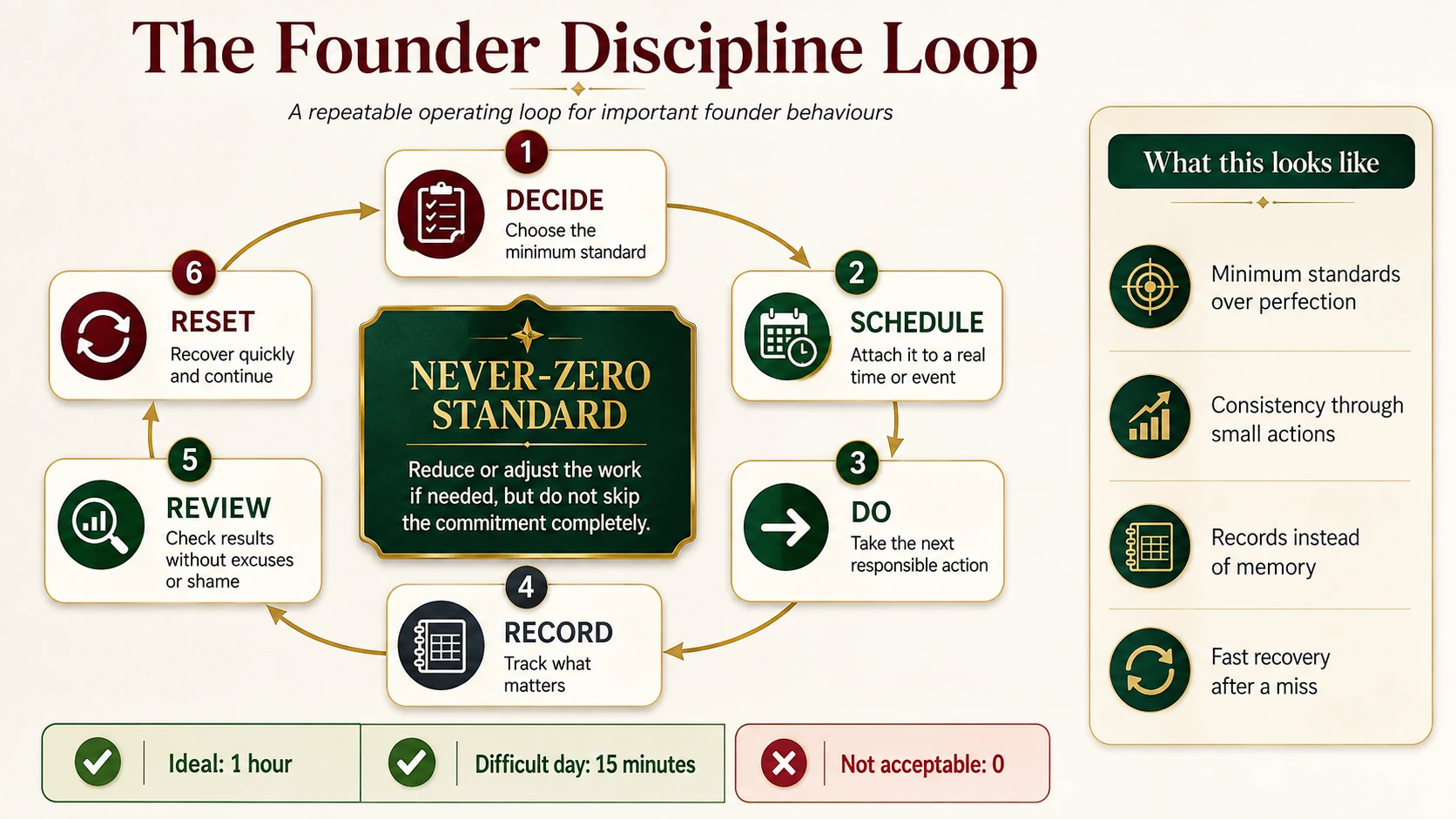
1. Decide the minimum standard
Choose a small standard you can keep on an ordinary day, not only on your best day. Examples include replying to open enquiries before 18:00, recording every payment before closing, confirming delivery dates in writing or finishing existing orders before advertising a new offer.
A minimum standard is not the most you can ever do. It is the level below which the business should not quietly fall.
2. Schedule the action
Attach the action to a time, place or existing event. “After my 16:00 lecture, I will spend 30 minutes on customer follow-ups.” “When I receive a payment, I will record it before using any of the money.” “Every Saturday morning, I will review stock and open orders.”
A realistic schedule is stronger than a vague promise to “be more serious.”
3. Do the next responsible action
When the moment arrives, begin with the smallest useful step. Open the order list. Send the first follow-up. Record the first transaction. Prepare the first delivery. Discipline grows through completed actions, not through repeatedly judging whether you feel ready.
4. Record what matters
Use a notebook, spreadsheet or simple phone note. Track only what helps you act responsibly: customer name, order, amount paid, balance, deadline and status. Do not wait for expensive software before building a record-keeping habit.
Records protect you from relying on memory and help you see whether the business is improving or only staying busy.
5. Review without excuses or shame
At the end of the week, ask what was completed, what was delayed and why. Was the schedule unrealistic? Did you accept too much work? Did personal spending affect business money? Did a missing tool or unclear process create the problem?
Honest review is more useful than calling yourself lazy. The aim is to correct the system, not attack your identity.
6. The Never-Zero Standard
When you commit to a goal, you may reduce or adjust the work when necessary, but you should not skip the commitment completely.
For example, if your goal is to work on your business plan for one hour each day; Completing the full hour is ideal, Working for 15 minutes because the day became difficult is acceptable, doing nothing at all is not acceptable.
The principle is about protecting consistency rather than demanding perfection. It recognizes that circumstances can affect how much work you complete, but you should still “show up” and perform the smallest useful version of the planned action.
On a difficult day, a founder may:
reduce the amount of work;
adjust the method;
reschedule part of the task; or
complete the minimum acceptable action.
However, the founder should not abandon the routine entirely. The purpose is to maintain momentum, reinforce reliability and make it easier to return to full performance.
The important qualification is that the action must be meaningful. Merely opening a document or thinking about the task should not count unless it genuinely moves the work forward.
7. Reset quickly after a miss
You will miss a day, make a mistake or face a disruption. Discipline does not mean never failing. It means returning to the standard before one miss becomes a month of avoidance.
Apologize where necessary. Communicate. Update the record. Adjust the plan. Continue. A founder who can recover responsibly is stronger than one who keeps waiting for a perfect restart.
A 14-day founder discipline experiment
For the next two weeks, choose only three non-negotiable actions. Keep them small enough to repeat and important enough to protect the business.
Area | Action |
|---|---|
Customer | Complete one customer action each day: reply, follow up, confirm or update. |
Money | Record every amount received or spent before the day ends. |
Delivery | Complete the most important unfinished order or task before starting a new idea. |
Daily check | Mark each action complete, missed or adjusted. Do not invent a good score. |
Day 7 review | Identify the biggest interruption and change one part of the system. |
Day 14 review | Decide which routines should continue, which need redesign and which were unnecessary. |
Day | Customer action | Money action | Delivery action | Score |
|---|---|---|---|---|
Day 1 | Follow up on Isaac | Save 10% from sales | Deliver on time | 100 |
Day 2 |
|
|
|
|
Day 3 |
|
|
|
|
Day 4 |
|
|
|
|
Day 5 |
|
|
|
|
Day 6 |
|
|
|
|
Day 7 |
|
|
|
|
A missed action is information, not proof that you are incapable.
Look for the cause. If the routine was too large, reduce it. If the time was unrealistic, move it. If you accepted more work than you could deliver, change the promise.
At the end of each day, give yourself one point for each action completed
The purpose is not to shame yourself when you miss a day.
It is to see your behavior clearly.
A low score does not mean you are incapable of running a business. It means your current structure needs improvement.
Review what interrupted you. Was the routine unrealistic? Were you accepting too much work? Were personal expenses affecting business money? Did you need a reminder, checklist or quieter working period?
Then adjust and repeat.
Discipline grows through honest review, not self-criticism.
You Do Not Have to Feel Ready Every Day
There will be days when you doubt the business.
There will be slow weeks, rejected proposals, difficult customers and moments when employment appears easier than entrepreneurship.
Those feelings do not automatically mean you should stop.
They may simply mean you are experiencing the ordinary difficulty of building something that requires patience, learning and responsibility.
- You do not have to feel confident before sending the follow-up message.
- You do not have to feel inspired before updating your records.
- You do not have to feel powerful before correcting a mistake.
Do the next responsible thing. Then do it again tomorrow.
That is how a side hustle becomes structured. It is how a freelancer becomes dependable. It is how a small trader earns trust. It is how a young founder gradually becomes capable of managing something larger.
Closing thought "Motivation may help you imagine the entrepreneur you want to become. Discipline is how you practice becoming that person". |
The quiet advantage of disciplined founders
Young entrepreneurs often feel pressure to look successful before the business is stable. Social media rewards announcements, launches and visible excitement. Customers, however, reward dependable outcomes.
The disciplined founder may not always look impressive. They may use a notebook before buying software. They may sell one clear service before adding five more. They may turn down an order they cannot fulfil. They may save part of a payment instead of celebrating every sale.
Those decisions build something motivation alone cannot build: trust.
Motivation may help you picture the entrepreneur you want to become. Discipline is the repeated practice of becoming trustworthy enough to carry more responsibility.
Start with one standard you can keep
Do not redesign your whole life tonight. Choose one behavior that would make your business more dependable this week. Decide when it will happen. Record it. Review it. Reset when necessary.
That is how a student project becomes organized. It is how a freelancer becomes easier to recommend. It is how an informal trader protects customer trust. It is how an early founder becomes capable of managing something larger without pretending that growth is guaranteed.
Practical Takeaways & Immediate Actions
Key takeaways
Motivation is useful for starting, but it changes with mood, pressure and results.
Discipline is a realistic operating system—not punishment, perfection or endless work.
Specific routines, cues and records make responsible action easier to repeat.
Customers experience discipline through communication, money handling, delivery and follow-through.
Founders should establish simple systems before pursuing rapid growth.
Missing a day is not the end; disciplined founders review, adjust and return quickly.

Immediate action steps
1. Choose one minimum standard for customers, money or delivery.
2. Attach the action to a specific time, place or event.
3. Record completion honestly for 14 days.
4. Review what interrupted you without shaming yourself.
5. Adjust the routine and continue before motivation returns.

Your next practical step
Download the AES Founder Discipline Checklist and identify the one routine that would most improve customer trust, money control or delivery consistency.
AscendEdge Solutions supports individuals, universities, youth groups, institutions and teams through practical training and capacity-building programs focused on planning, accountability, execution and sustainable improvement.
Start by reviewing your current habits honestly. Identify the promises you keep, the routines you avoid and the one area where greater discipline would make your business more trustworthy.
Then build from there - one completed action at a time.
Share Article
Explore AES support: Individual Consultation | Business Consultation