
A familiar kind of waiting
Consider this common, composite situation.
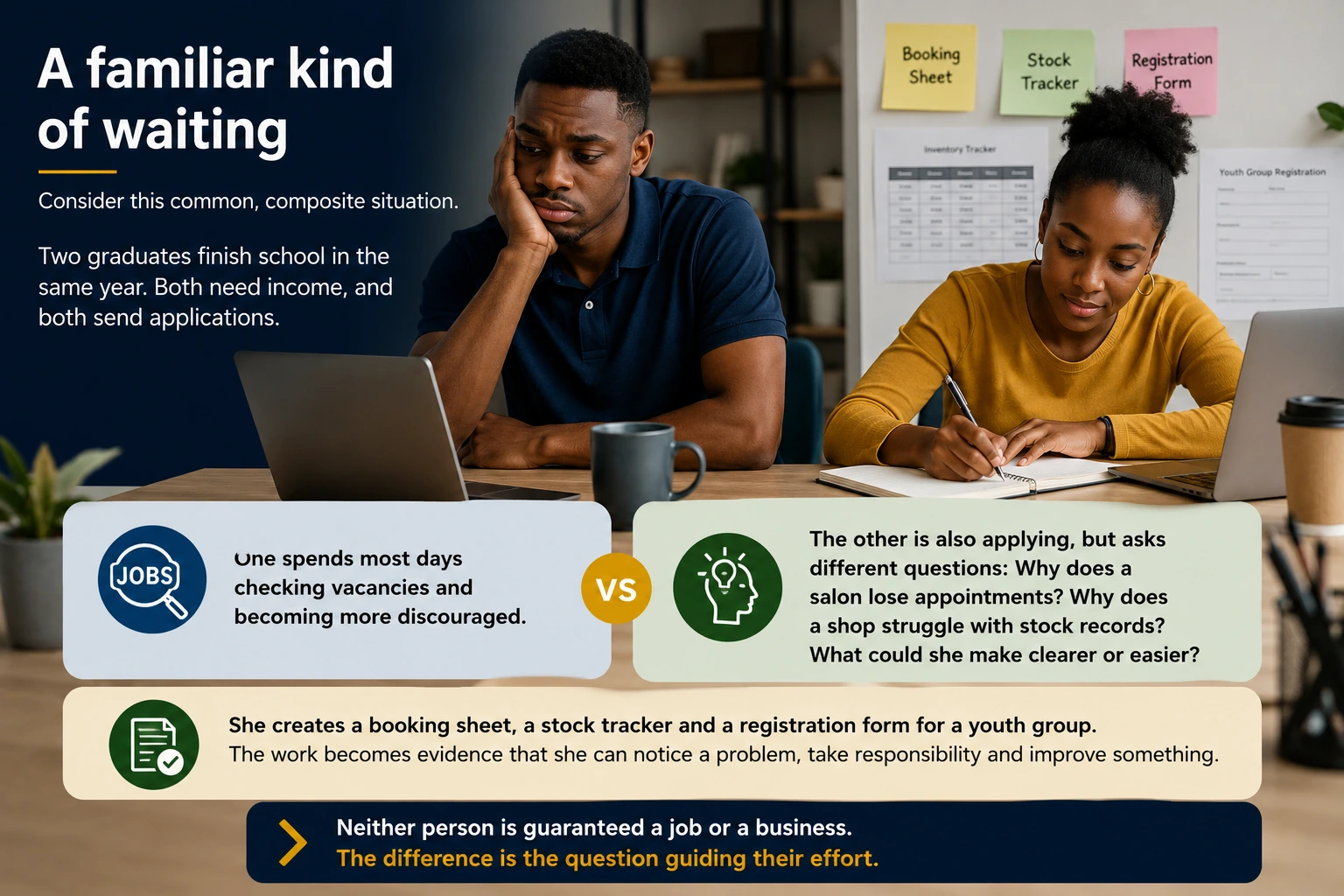
Two graduates finish school in the same year. Both need income, and both send applications.
One spends most days checking vacancies and becoming more discouraged.
The other is also applying, but asks different questions: Why does a salon lose appointments? Why does a shop struggle with stock records? What could she make clearer or easier?
She creates a booking sheet, a stock tracker and a registration form for a youth group. The work becomes evidence that she can notice a problem, take responsibility and improve something.
Neither person is guaranteed a job or a business. The difference is the question guiding their effort.
The mindset shift Do not only ask: “Who will give me an opportunity?” Also ask: “What useful result can I create with what I know, what I can learn and what people need?” |
Looking for a job is not the problem
Employment is a valuable path that can provide income, experience, mentorship and stability. This article is not telling young people to stop applying or to treat entrepreneurship as superior.
The problem begins when job seeking becomes only a waiting activity: waiting for a vacancy, waiting for someone to notice your certificate, waiting for permission to use your abilities.

A value-creation mindset makes the job search more active. It asks you to look beyond the title you want and understand the result an employer, customer or community needs.
An employer is not only hiring “a graduate.” The organization needs useful results: fewer errors, better information, stronger service, clearer writing, project support or faster learning. A customer is also paying for a problem to be reduced or an outcome produced.
What creating value really means
The European Commission’s EntreComp framework describes entrepreneurship broadly as acting on opportunities and ideas to create financial, cultural or social value for others.
Value creation is not limited to registering a company. It includes improving a process, making information easier to use, reducing waste, solving a community problem or turning a skill into a dependable result.
This mindset can strengthen four different paths:
- Employment: You become a candidate who can show evidence of initiative and useful results.
- Freelancing: You package a skill around a specific client problem instead of offering vague services.
- Entrepreneurship: You start with customer needs and test a solution before spending heavily.
- Community leadership: You help a group organize, communicate or solve a local challenge more effectively.
The World Economic Forum’s Future of Jobs Report 2025 identifies analytical and creative thinking, resilience, flexibility, agility and technological literacy among increasingly important skills. They become credible when used to produce something useful, not only listed on a CV.
The shift changes how you see your skills
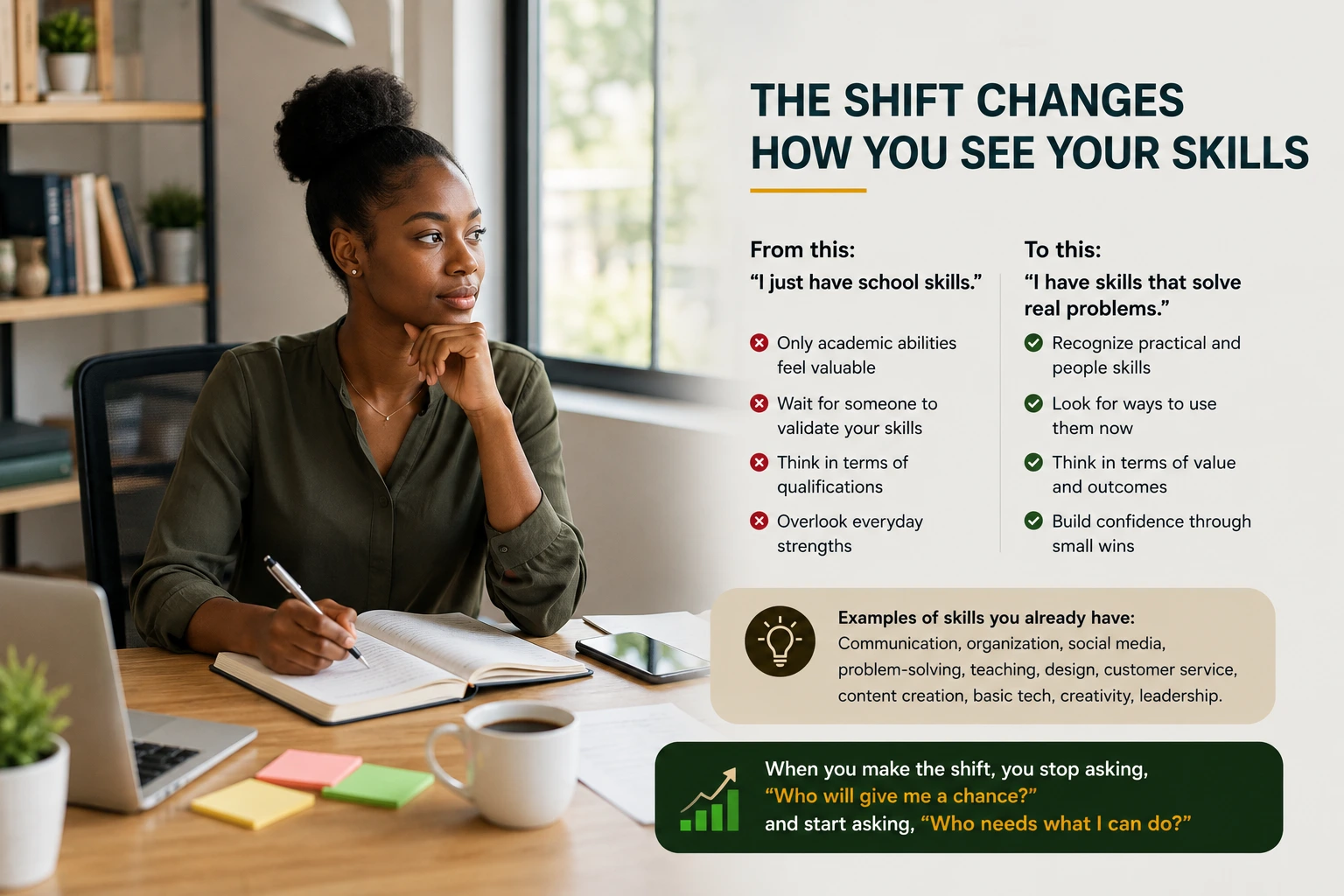
A certificate shows what you studied. Value creation shows what you can do with what you studied.
A marketing graduate can move from “I need a marketing job” to “I can help a small food business understand customers and organize a four-week content plan.” An IT graduate can offer to organize device records or improve a basic file structure within safe limits.
The same applies to tailoring, hairdressing, photography, bookkeeping, tutoring or electrical work. Explain the problem the skill solves and the result it creates.
Be honest about your level. Start with small problems you can handle responsibly, and recognize when supervision, certification or deeper expertise is required.
The shift changes how you build confidence
Many young people are told to become confident before they act. In practice, confidence often grows after you collect evidence that you can learn, finish and improve.
Organizing one trader’s stock records or interviewing five potential users may teach you more than another week of logos and plans based on assumptions. One completed project can strengthen a portfolio more than describing yourself as hardworking.
Confidence built on proof is stronger. You can explain the problem, what you tried, what changed and what you would improve.
A practical V.A.L.U.E. framework
Use this five-step framework to move from waiting to useful action.
V View | A Ask | L Link | U Undertake | E Evidence |
|---|
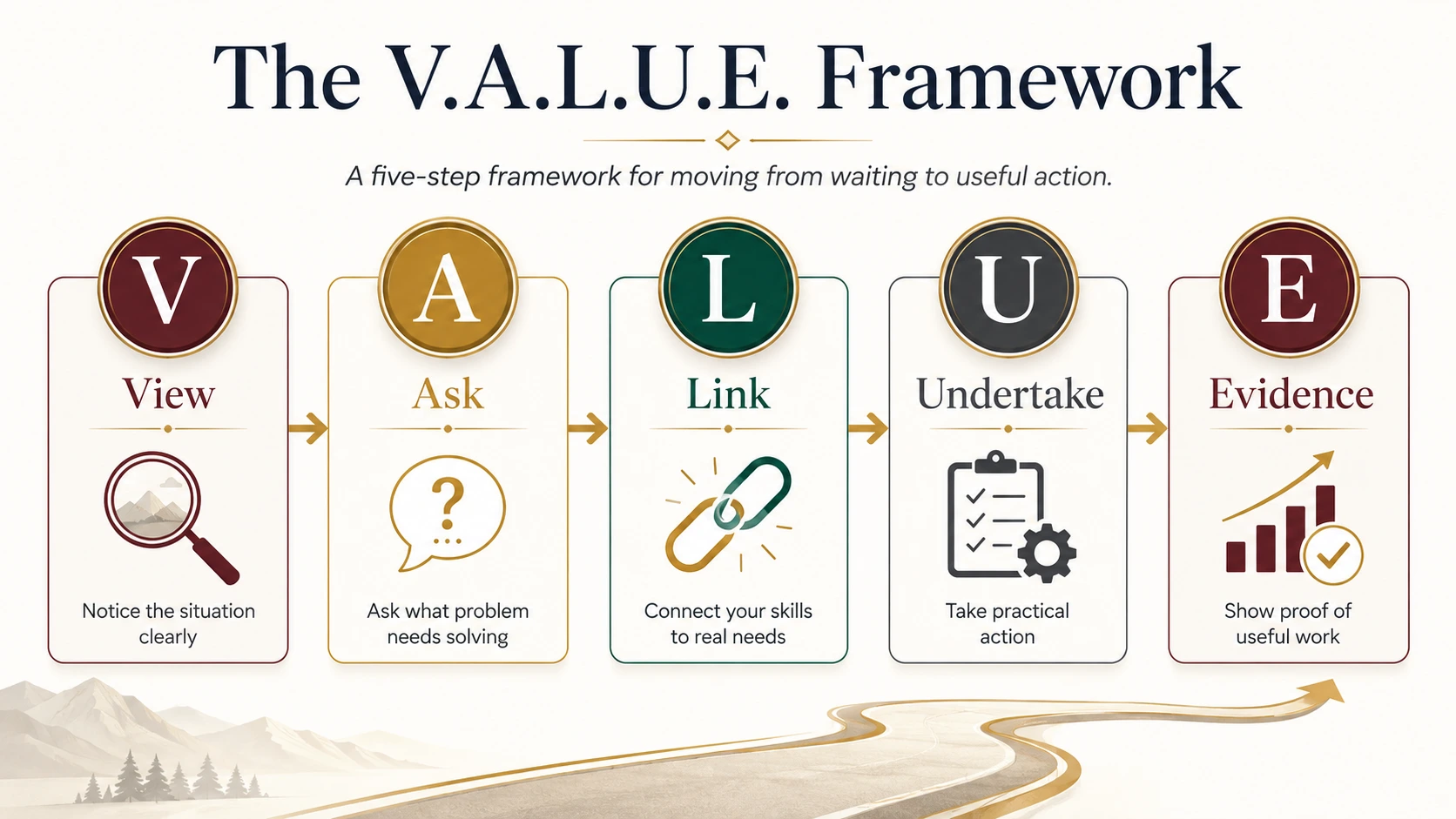
V — View your environment
Notice repeated frustrations. What wastes time, causes confusion, keeps being forgotten or remains unreliable?
A tutoring center may struggle with attendance, an online seller with repeated delivery questions, or a community group with member information.
A — Ask and listen
Speak to the people affected. Ask what happens now, what they have tried and what a useful improvement would look like.
L — Link a skill to the need
Identify what you can contribute now and what you must learn. It may be research, communication, design, record keeping, coordination, repair, teaching or service.
Keep the promise small and specific. “I can help you organize a simple booking system” is more credible than “I will transform your whole business.”
U — Undertake a small test
Test the smallest useful version: a sample, one-week pilot, organized process, first customer or one solved part of the problem.
A small test gives feedback without large capital and shows whether the result is useful enough to continue, recommend or pay for.
E — Evidence the result and improve
With permission, record the starting problem, your action, the feedback and the next improvement. Remove confidential details and show your thinking, not only finished pictures.
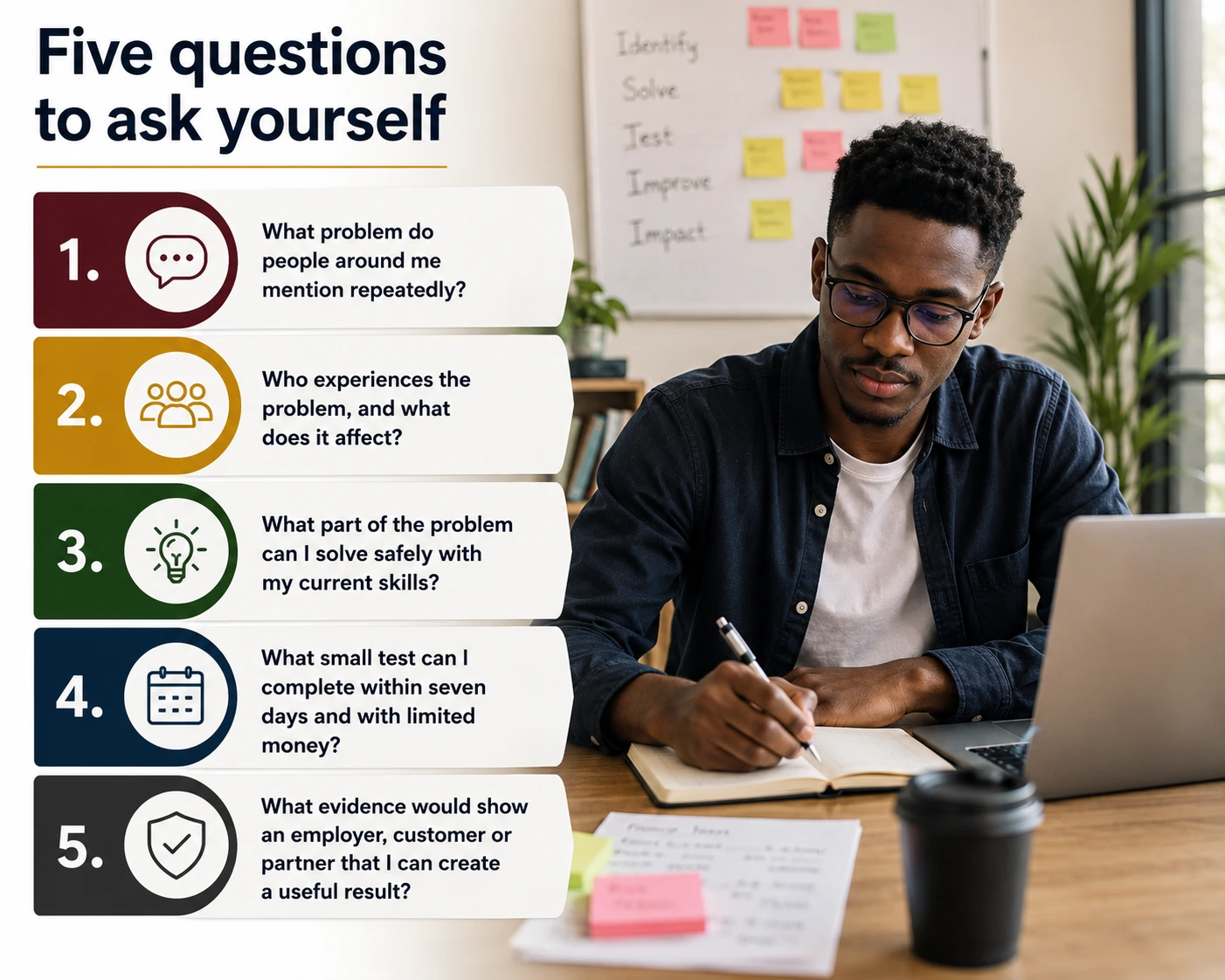
Five questions to ask yourself
1. What problem do people around me mention repeatedly?
2. Who experiences the problem, and what does it affect?
3. What part of the problem can I solve safely with my current skills?
4. What small test can I complete within seven days and with limited money?
5. What evidence would show an employer, customer or partner that I can create a useful result?
A seven-day value-creation challenge
Day | Action |
|---|---|
Day 1 | Write down ten problems you have observed at school, work, in a local business, online or in your community. |
Day 2 | Choose one problem and speak to three people who experience it. Listen before suggesting a solution. |
Day 3 | Define one small result you could create. State what is included, what is not included and what you still need to learn. |
Day 4 | Build a simple sample, checklist, process, service outline or prototype. |
Day 5 | Test it with one person or one small group. Ask for honest feedback. |
Day 6 | Improve the solution based on what you learned. |
Day 7 | Document the problem, action, feedback and next step in a one-page portfolio note. |
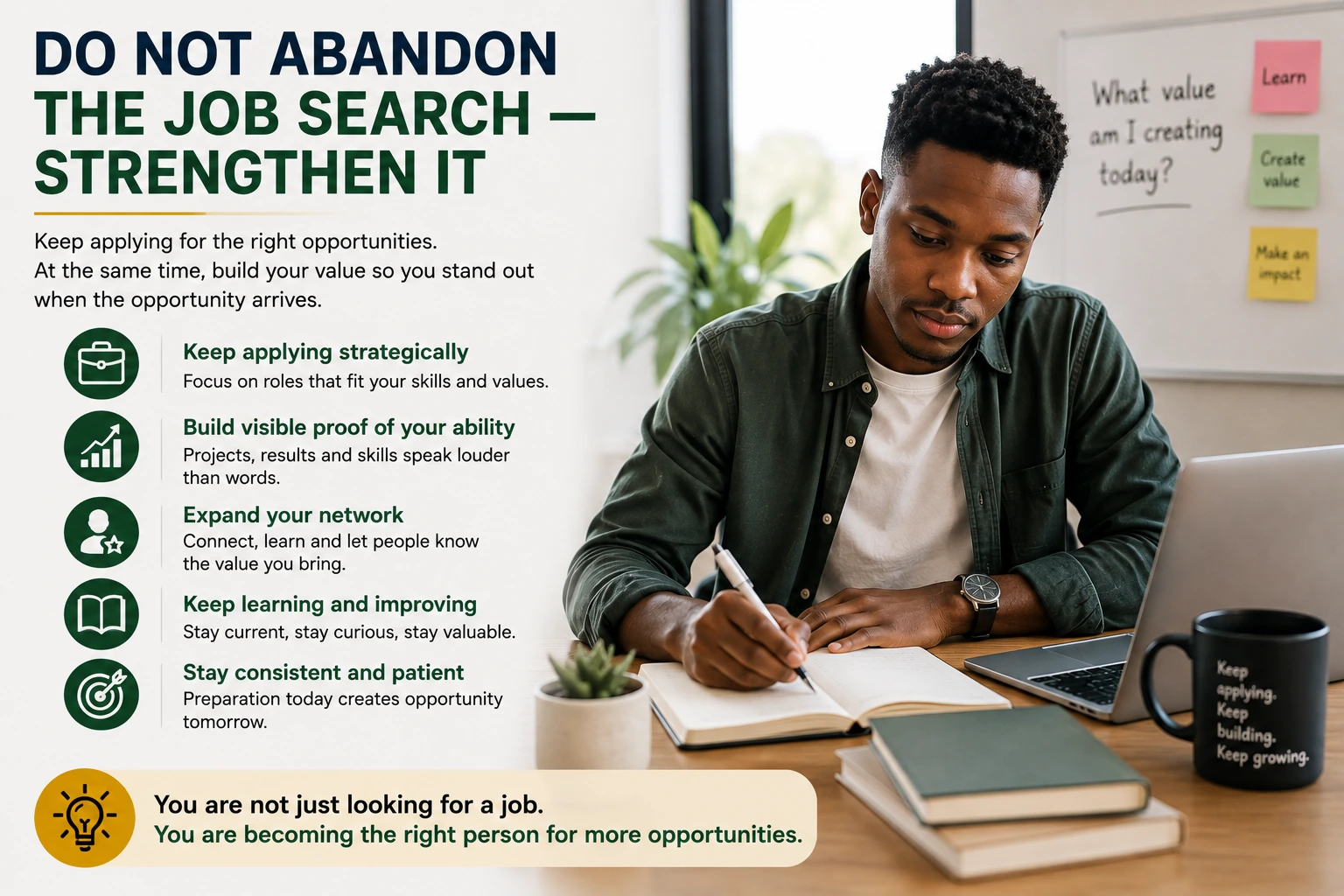
Do not abandon the job search — strengthen it
Continue applying for suitable roles. Improve your CV, prepare for interviews, seek referrals and research the organizations.
At the same time, build evidence of usefulness. A small project can reveal strengths and gaps, and become a portfolio item, reference, freelance offer, business test or interview example.
Do not stay permanently busy with unpaid work. Set boundaries and choose projects that teach you, create credible evidence or have a realistic path to paid value.
The mindset shift is simple: your future should not depend only on being selected. You can also observe, learn, test, improve and create value while you pursue the right opportunity.
Start with one useful result
You do not need large capital, a perfect idea or an impressive title to think like a value creator.
Start with one person, one problem and one responsible test. Learn, keep your promises and document the result. It may lead to work, freelancing, a small enterprise or clearer direction.
Employment, entrepreneurship and further study can all be part of the journey. Every path is strengthened by the ability to see a need and contribute something useful.
Practical Takeaways and Immediate Actions
Key takeaways
- Looking for employment is valid, but passive waiting should not become the only strategy.
- A value-creation mindset asks what problem can be reduced, what result can be improved and who benefits.
- Small, responsible projects create evidence of skills, initiative and reliability.
- The same mindset supports employment, freelancing, entrepreneurship and community leadership.
Immediate action steps
1. List ten recurring problems you notice around you.
2. Choose one problem and interview three people affected by it.
3. Define a small result you can create within seven days.
4. Test the solution, request feedback and document what you learned.
5. Add the evidence to your portfolio, CV, profile or business learning record.

Your next practical step
Download the AES Value Creation Worksheet and use it to identify one real problem, speak to the people affected and design a low-cost seven-day test.
AscendEdge Solutions also supports individuals, universities, youth groups and institutions through practical training and capacity-building programs that strengthen readiness, problem-solving, structure and execution.
Share Article
Explore AES support: Individual Consultation | Business Consultation