
Formal policies explain what should happen.
Hidden rules explain what people believe will actually happen when they speak, decide, make a mistake, ask for help or challenge authority.
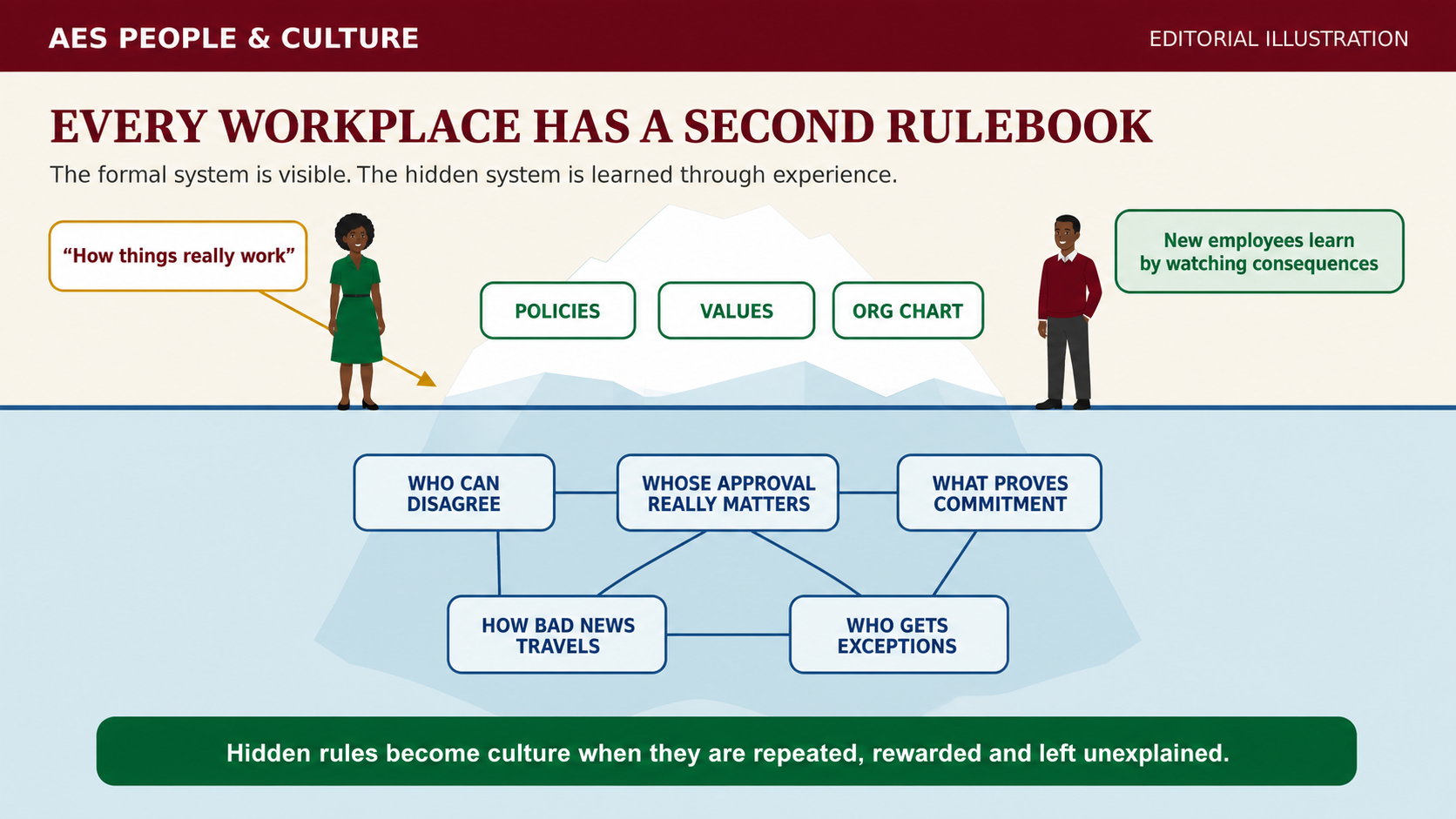
Figure 1. The formal workplace is visible; the hidden rulebook is learned through repeated experience.
Every workplace develops unwritten expectations about who can disagree, how problems are raised, what counts as commitment and whose decisions matter.
This article explains how hidden rules form, how they affect performance and fairness, and how leaders and HR teams can replace harmful norms without turning the workplace into a bureaucracy.
The workplace reality: the second rulebook nobody hands you
A new employee joins a growing organization and receives a detailed handbook. It explains working hours, reporting lines, leave procedures, values and performance expectations.
Within a few weeks, however, the employee learns a second rulebook.
The official meeting starts at 09:00hrs in the morning, but nobody begins until the director arrives. Staff are told to raise risks early, but people who bring difficult news are described as negative.
The organization says ideas are welcome, but employees know that challenging a senior person in the room is risky. Leave may be approved, yet those who leave on time while the manager is still working are quietly judged as less committed.
None of these rules appears in the handbook.
Nobody formally teaches them. Still, most people learn them quickly because they watch what happens to others.
This shows a familiar reality: every workplace develops unwritten expectations about what is safe, respected, tolerated and rewarded.
What hidden workplace rules are
Hidden workplace rules are the informal expectations people use when written policies are incomplete, unclear or contradicted by everyday practice.
They answer questions such as:
Who is allowed to disagree?
How much bad news can be shared with a manager?
Does a deadline matter more than quality?
Is asking for help seen as responsibility or lack of seriousness?
Who receives exceptions?
What counts as commitment?
Which mistakes are forgivable, and for whom?

Not every unwritten rule is harmful.
Teams need informal routines, and colleagues often develop useful habits for sharing information, helping new staff or handling urgent work. The problem begins when important expectations remain invisible, inconsistent or unfair - especially when they undermine policies , silence concerns or give some people access that others do not have.
A workplace can therefore look well structured on paper while being governed in practice by assumptions that employees must discover through observation, trial and mistakes.
Why this idea is supported by established research
1. Culture operates below the visible surface
Edgar Schein’s model of organizational culture distinguishes between visible artifacts, stated values and deeper underlying assumptions. The policy may say one thing, while shared assumptions about authority, risk or acceptable behavior guide what people actually do. Schein’s work reminds leaders that culture cannot be understood only by reading the values statement or handbook. [1]
2. People read what is normal and what is approved
Research on social norms distinguishes between descriptive norms - what people see others doing; and injunctive norms - what people believe others approve or disapprove of.
Employees read both.
They notice which behavior is common and which behavior attracts praise, protection or criticism. [2]
3. Newcomers learn through formal and informal socialization
Organizational socialization research explains why hidden rules spread. Newcomers learn not only through induction but through repeated interaction, observation and feedback. They study experienced colleagues to understand how the workplace really operates. [3]

4. Silence can become a learned team rule
Amy Edmondson’s research on psychological safety shows why a workplace may request openness but receive silence. When people believe that speaking up, admitting uncertainty or reporting an error carries interpersonal risk, they avoid those actions.
This weakens learning because concerns surface late, if at all. [4]
CIPD evidence reviews similarly encourage organizations to move beyond vague culture claims and examine specific behaviors, norms, management practices and workplace climate. [5]
Why hidden rules develop
Leadership behavior outweighs policy. When senior people interrupt, bypass procedures, protect favorites or reject uncomfortable information, employees adapt to the example.
Ambiguity creates a vacuum. Where roles, decision rights, escalation paths or standards are unclear, teams invent their own operating rules.
Past consequences become collective memory. One person is criticized for raising a concern, and others learn to keep quiet until they have certainty.
Informal power fills structural gaps. A long-serving employee, founder’s confidant, administrator or technical specialist may become the person whose approval matters, even when the organization chart says otherwise.
Workarounds become traditions. A temporary shortcut created during a crisis can remain, long after the crisis ends because “this is how we have always done it.”
Pressure narrows behavior. Under tight deadlines or limited resources, teams may reward availability over planning, speed over accuracy or rescue over sustainable systems.
New employees copy what succeeds. When onboarding explains policy but not real decision-making, newcomers watch who is trusted, heard and protected.
The business and human impact
Decision quality declines because people filter information before it reaches leaders.
Onboarding slows because new employees spend time reading personalities and politics instead of learning the work.
Consistency weakens when the same request receives a different answer depending on who asks or which manager is present.
Accountability becomes unfair because employees are judged against standards that were never made clear.
Operational risk rises when errors, customer complaints, safeguarding concerns, project delays or compliance issues remain hidden.
Change efforts stall when the real rule is “wait and see whether leadership means it” or “keep using the old process until someone forces us to stop.”
Trust declines because employees stop relying on official messages and follow the rulebook they have learned through experience.
Common hidden rules worth examining
“Bring solutions, not problems.” This can encourage ownership, but it becomes dangerous when employees delay raising risks until they have a complete answer.
“Do not disagree with a senior person in public.” This may protect face, but it can leave weak decisions untested.
“Staying late proves commitment.” This rewards visibility and availability even when work could have been planned or delegated better.
“Relationships move work faster than process.” Informal cooperation can help, but dependence on personal access creates unfairness and weak continuity.
“High performers receive different rules.” Protecting results at the expense of conduct tells everyone that standards are negotiable.
“Do not admit a mistake until you can fix it.” This encourages concealment precisely when early information would reduce the damage.
“Ask permission before taking initiative.” This may be sensible in high-risk work, but when applied everywhere it creates bottlenecks and dependence.
The goal is not to remove all informal behavior.
It is to identify where informal rules support good work and where they quietly contradict the organization’s stated expectations.
A practical response: the R.U.L.E.S. culture review
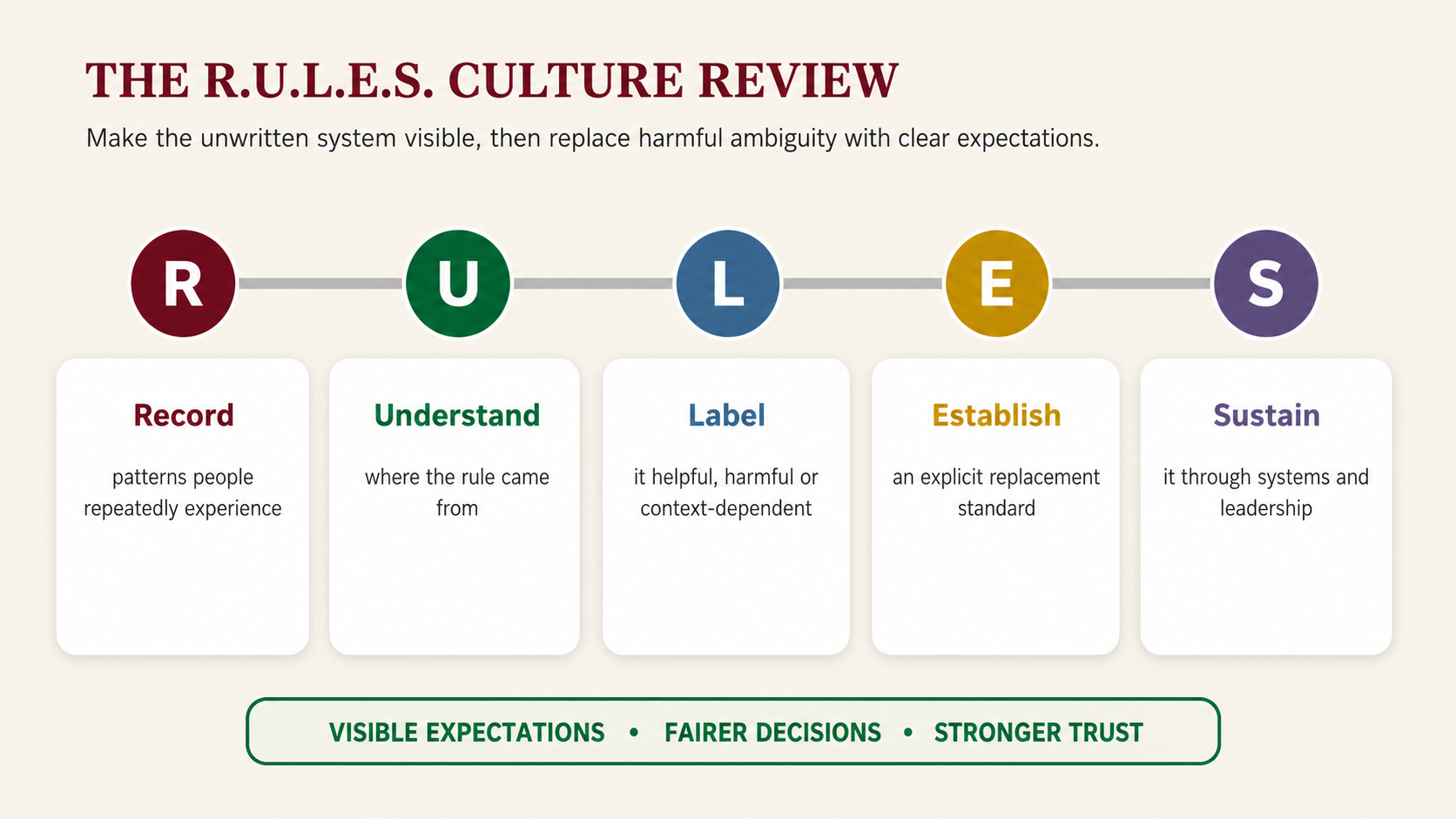
Figure 2. The R.U.L.E.S. culture review helps leaders make unwritten expectations visible and replace harmful ambiguity.
R - Record the patterns people repeatedly experience. Ask what gets someone praised, ignored, criticized, trusted or excluded. Look across meetings, approvals, workload, conflict, promotion and access to information.
U - Understand where each rule came from. Was it created by a past incident, a founder’s preference, a control failure, a customer requirement or a temporary crisis? Identify who benefits, who carries the cost and what risk the rule was trying to manage.
L - Label the rule as helpful, harmful or context-dependent. A rule may be useful in one setting and damaging in another. Approval before a public statement may be sensible; senior approval for every routine customer response may not be.
E - Establish an explicit replacement. Replace “do not bring bad news” with a clear escalation standard: raise material risks early, state what is known and unknown, and identify the support needed.
S - Sustain the standard through systems and leadership. Update onboarding, manager briefings, meeting routines, performance discussions, recognition and escalation processes. Leaders must model the replacement rule when it is inconvenient, not only when the stakes are low.
The purpose is not to make every interaction bureaucratic. It is to make important expectations clear enough that performance and fairness do not depend on insider knowledge.
What different workplace roles should do
Executives and business owners: Examine the contradictions created by leadership behavior. Invite bad news, explain decisions, respect agreed processes and avoid unexplained exceptions.
HR and people operations teams: Compare written policy with actual practice. Onboarding, performance management, promotion, discipline, grievance channels and manager training should reinforce the same standards.
Managers and supervisors: Explain expectations employees would otherwise have to guess. Distinguish reasonable challenge from disrespect, responsible escalation from complaining, and genuine urgency from poor planning.
Employees and team members: Ask clarifying questions, raise patterns respectfully and use appropriate reporting channels.
The burden of fixing hidden rules, however, must not be placed mainly on employees where power differences make challenge risky.
Mistakes organizations should avoid
Running a culture survey and treating the score as the solution.
Asking people to speak freely without protecting confidentiality or responding safely.
Naming individual “culture problems” before examining systems, incentives and leadership behavior.
Publishing new values while leaving decision rights, workload and consequences unchanged.
Punishing employees for breaking expectations that were never explained.
Trying to eliminate every informal relationship or routine, including those that help work move.
Assuming one organization-wide culture exists when departments, sites and professional groups may follow different rules.
Treating silence as agreement instead of asking whether people believe it is safe or useful to speak.
The question that exposes the real culture
Ask employees and managers separately: “What does a new employee have to learn here that nobody explains?”
Then compare the answers with the handbook, policies, leadership messages and performance expectations.
The gaps show where the real culture is operating.

The bottom line
Every workplace has a formal structure and an informal one.
The formal structure appears in policies, reporting lines, job descriptions and values.
The informal structure appears in who people consult before a decision, what they avoid saying, which deadlines can move, who receives the benefit of the doubt and what behavior earns trust.
Healthy organizations do not pretend the informal system can be removed. They make it visible enough to examine. They protect helpful norms, challenge harmful ones and ensure that important expectations do not depend on belonging to the right circle.
The hidden rulebook will exist either way.
The leadership question is whether it supports the workplace you are trying to build.

What to do Next
If your policies appear clear but workplace behavior still depends on who is asking, who is present or what a particular manager prefers, the issue may sit across role clarity, management practice, performance systems and people operations. AscendEdge Solutions’ HR & People Operations support helps organizations review and strengthen the systems that shape everyday behavior.
Begin with the HR Maturity Checklist to identify where written expectations and actual practice may be drifting apart.
Share Article
Related Articles
Culture Is Not What You Say - It Is What You Reward (The People & Culture)
How Informal Power Structures Affect Performance (The People & Culture)
What Your Meetings Reveal About Your Culture (The People & Culture)
The Culture Audit Every Growing Business Should Run Annually (The People & Culture)
The Businesses That Scale Successfully Think in Systems, Not Effort (In Business Today)
Why Digital Transformation Needs Change Management (Digital & IT Insights)