
The workplace reality: the lesson hidden inside a "thank you"
On a Monday morning, a leadership team reminds employees that the organization values openness, teamwork and early problem-solving.
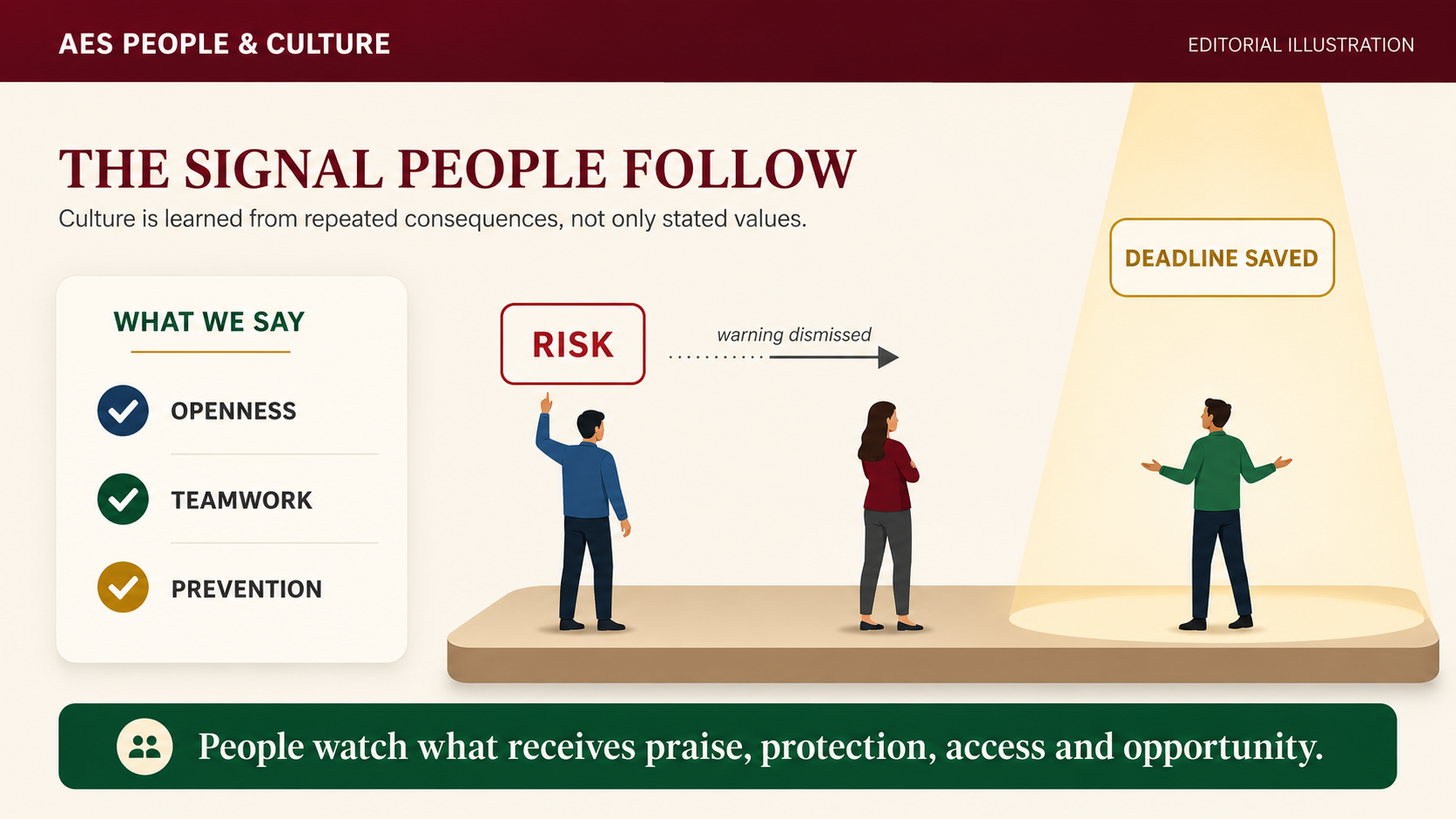
On Thursday, a project officer raises a delivery risk during a meeting. The manager looks irritated and says, "Do not bring problems without solutions." The discussion moves on.
Two weeks later, the risk becomes a crisis. A senior employee works through the weekend, calls several suppliers and helps rescue the deadline. On Monday, leadership praises that person publicly for commitment and going the extra mile.
Nobody mentions the employee who raised the risk early. Nobody examines why the warning was dismissed. The crisis rescue becomes the story everyone remembers. The stated value is teamwork. The rewarded behavior is individual rescue.
The team has just learned that preventing a crisis is less visible than rescuing one. Speaking early may be ignored. Exhaustion earns recognition. Heroics attract attention.
This pattern appears in many forms.
A school says collaboration matters but promotes only the teachers with the strongest individual results. An NGO says openness matters but managers become defensive when staff report project risks. A growing business says customer service matters but rewards sales volume even when employees make promises operations cannot keep.
The details change, but the cultural lesson is the same: employees study consequences more closely than slogans.
The stated culture may value prevention. The experienced culture rewards rescue.

The central idea "People pay attention to what earns praise, promotion, protection, resources, access and status. They also notice what is ignored, tolerated or punished. Those signals teach the real rules of the workplace." |
The headline is deliberately sharp - but not simplistic
"Culture is not what you say; it is what you reward" is intentionally provocative.
It does not mean rewards are the only force shaping culture. Organizational history, leadership assumptions, power, social norms, structures and daily routines also matter.
The point is narrower and more practical: reward signals are among the clearest ways leaders show what the organization truly values. When official language says one thing but praise, promotion, access and protection consistently favor something else, employees adapt to the consequences they can see.
Edgar Schein's work on organizational culture identified leadership mechanisms such as what leaders pay attention to, measure, resource, reward and control, as well as the criteria used for recruitment, promotion and removal. These repeated decisions help embed culture because they show which behaviors carry real weight. [1]
What “reward “ means in workplace culture
Reward does not mean money alone. Salary increases and bonuses matter, but workplaces can reward behavior through:
public praise and private access to senior leaders;
promotion, high-profile assignments and development opportunities;
flexibility, autonomy and influence over decisions;
protection from scrutiny or consequences;
workload relief, preferred schedules or informal privileges;
attention, visibility and the simple decision to tolerate something.

This does not mean every reward is deliberate. Many cultural signals are accidental. Leaders may sincerely want collaboration, accountability and ethical behavior while operating systems that make competition, concealment or short-term results more attractive.
A manager rewards lateness when one favored employee is never challenged. A school rewards competition when only individual results are celebrated, even though staff are asked to collaborate. An NGO rewards silence when people who raise program risks are treated as disloyal. A business rewards overpromising when sales targets matter more than whether operations can deliver what was sold.
Employees notice these signals. They ask, often silently:
What gets someone ahead here?
What gets ignored?
What gets punished?
Who is allowed an exception?
Why the idea is supported by established research
The statement that culture is shaped by what an organization rewards is not a fashionable slogan. It reflects several established ideas in organizational behavior and motivation research.
1. Edgar Schein: stated values are not the whole culture
Edgar Schein’s organizational culture model distinguishes between visible artifacts, stated or “espoused” values, and deeper assumptions that guide behavior. In his work on how leaders embed culture, Schein identifies recurring leadership signals such as what leaders pay attention to, measure and control; how they allocate resources; how they assign rewards and status; and whom they recruit or promote. In practical terms, employees compare what leaders say with what leaders repeatedly do. The repeated action usually wins.
2. Organizations often reward A while hoping for B
Steven Kerr's classic article, "On the Folly of Rewarding A, While Hoping for B," described a recurring management problem: organizations hope for one behavior while rewarding another. A team may be told to cooperate while performance systems recognize only individual results. Managers may request honest reporting while reacting badly to unwelcome information. Quality may be listed as a priority while speed is the only measure that affects bonuses or praise. The contradiction is not harmless. It makes the unwanted behavior rational. [2]
3. Reward design and fairness matter
The CIPD's evidence review of incentives and recognition cautions against treating reward as a mechanical lever. Financial and non-financial rewards can influence motivation and performance, but the effects depend on design, fairness, context and what the system actually encourages. [3]
4. Motivation is not only about external incentives
The basic reinforcement principle is straightforward: behavior followed by a valued consequence is more likely to be repeated. However, good culture design is not as simple as paying people for every desired action. Self-Determination Theory and related research warn that controlling or poorly designed external rewards can weaken intrinsic motivation. Effective recognition should therefore support competence, autonomy, fairness and connection - not reduce every contribution to a prize. This distinction matters. The goal is not to turn culture into a bonus scheme. The goal is to make sure everyday signals do not contradict the behavior the organization says it needs. [4]
5. Punishing bad news delays learning
Amy Edmondson's research on psychological safety showed why people need to believe that interpersonal risks - such as asking a question, admitting an error or raising a concern - will not automatically lead to embarrassment or punishment. When bad news is punished, organizations do not eliminate the risk. They often delay hearing about it. [5]
Why organizations reward the opposite of their values
Values are too vague to guide decisions. Words such as integrity, excellence, respect and teamwork are not translated into observable behavior, they sound positive, but they mean little until leaders define the behaviors that demonstrate them in real situations.
Results are assessed without examining how they were achieved. An employee may hit the target while damaging trust, hiding risk or creating work for another department. If only the number counts, the method becomes culturally invisible.
Crisis work is more visible than prevention. A dramatic rescue is easy to praise. Quiet planning, documentation and risk prevention receive less attention.
Informal recognition outweighs formal policy. The performance form may mention collaboration, but the manager's attention goes to the loudest person, the closest adviser or the employee always available after hours.
High performers receive exemptions. When strong results protect someone from consequences for disrespect or poor teamwork, values become optional for people with power.
Short-term pressure overrides long-term values. During a crisis, leaders may accept shortcuts, disrespect or unsafe workloads because the immediate result feels urgent. Repeated exceptions become norms.
Dependability attracts more work. Reliable employees are often "rewarded" with every urgent task. Competence becomes a route to overload rather than growth.
Consequences are inconsistent. When the same behavior is praised in one person and punished in another, employees stop trusting the value and start studying power.
The business impact of rewarding the wrong behavior
Misaligned rewards create more than employee frustration. They affect how work is performed and what information reaches decision-makers. People optimize for the measure rather than the purpose behind it. Departments protect their own targets even when the wider organization suffers. Employees hide delays until they have a rescue plan. Prevention declines because it receives little attention. Ethical concerns become negotiable when strong results provide protection.
Trust also weakens. Once employees conclude that values are mainly public language, future culture campaigns are treated with skepticism. Posters, town halls and values campaigns can then make the problem worse because they highlight the distance between what the organization says and what people experience.
The damage can appear as rework, avoidable conflict, inconsistent service, delayed risk reporting, burnout, poor handovers and the loss of capable employees who no longer believe contribution is recognized fairly.
The wider workplace context makes this especially important. Gallup’s 2026 State of the Global Workplace report found that 20% of employees worldwide were engaged in 2025. That figure does not prove that reward misalignment causes disengagement, but it reinforces the need to treat daily management signals as a performance issue rather than a decorative HR concern. [6]

A five-question culture reality check
Before changing the values statement, ask:
Who was promoted, praised or given important opportunities in the past year - and what behavior did those decisions reward?
What normally happens to the person who raises bad news early?
Which behaviors are tolerated from high performers that would be corrected in someone else?
Do performance discussions assess both results and how those results were achieved?
Are dependable employees developed and supported, or simply given more work?
The answers reveal the culture employees are learning.
A practical response: the R.E.W.A.R.D.S alignment framework
Organizations do not need to redesign every people-management system at once. They need a disciplined way to identify the signals employees receive, understand how those signals shape behavior and bring them closer to the culture the organization intends to build.
The R.E.W.A.R.D.S. Alignment Framework helps leaders examine both formal systems and everyday workplace practices so that values, performance expectations, recognition and consequences reinforce the same standards.
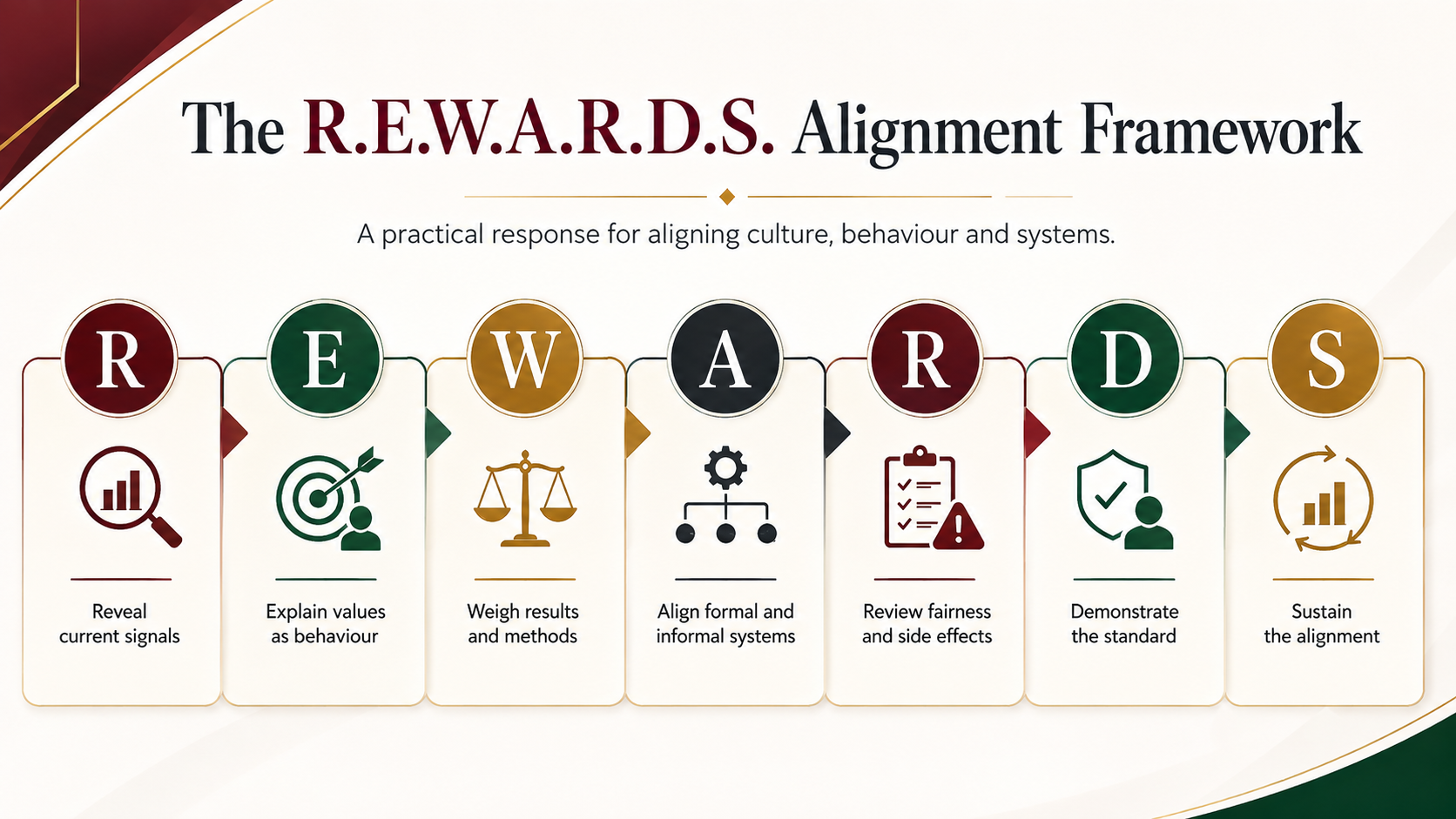
R - Reveal the current signals: List what currently earns praise, promotion, special access, flexibility, important assignments and protection. Also identify behaviors that are tolerated without consequence. Look beyond written policies and review recent decisions. Ask employees what someone must do to succeed in the organization. Their answers may reveal the real culture more accurately than the official values statement.
E - Explain values as observable behavior: Translate each value into a small number of actions. For example, “accountability” might mean raising risks early, keeping commitments, documenting decisions and asking for help before a deadline becomes a crisis. “Teamwork” might mean sharing information, supporting effective handovers, addressing conflict constructively and solving shared problems across departments. Values become useful only when employees understand what they look like in daily work.
W - Weigh results and methods together: Performance matters, but so does the way results are achieved. Review both the outcome and the conduct behind it. Do not allow strong numbers to erase harmful behavior, nor praise good intentions without reasonable delivery. Consider factors such as collaboration, judgement, ethics, client impact, respect for procedures, leadership behavior and long-term organizational consequences. Good intentions should not replace reasonable delivery. At the same time, strong numbers should not excuse harmful conduct, unethical decisions or damage to colleagues and customers.
A - Align formal and informal systems: Review whether the organization’s operating systems support the behaviors it claims to value. Check targets, performance reviews, promotions, recognition, workload allocation, disciplinary practice, meeting routines and leadership attention.
Informal systems must also be considered. Who is heard in meetings? Who receives the most interesting assignments? Who is allowed to bypass procedures? Whose mistakes become learning opportunities, and whose mistakes become permanent labels?
A value remains weak when the HR policy supports it but everyday management practices send the opposite message.

R - Review fairness and unintended effects: Ask who receives recognition, who is overlooked and whether employees have a fair opportunity to demonstrate the desired behaviors. Can decisions be explained using clear criteria? Do popularity, seniority or personal relationships influence outcomes?
Every reward system also creates side effects. Examine whether a reward encourages shortcuts, rivalry, silence or unnecessary heroics. When employees respond rationally to poorly designed incentives, the organization should correct the system rather than simply blaming individuals.
D - Demonstrate the standard consistently: Leaders must model the behavior when it is inconvenient. Culture changes when people see a manager thank someone for raising a risk, refuse to protect a toxic high performer, recognize quiet prevention work and accept accountability for a leadership mistake. Consistency does not mean ignoring context. It means that decisions can be explained using fair, relevant and transparent criteria.
S – Sustain the Alignment: Reward-system alignment should not be treated as a once-off HR exercise.
Monitor whether the desired behaviors are becoming more common and whether contradictory signals continue to appear. Use employee feedback, performance reviews, promotion decisions, disciplinary cases, complaints, turnover patterns and operational results to identify gaps.
Leaders should periodically ask:
Are employees receiving clearer and more consistent signals?
Are the desired behaviors being recognized?
Are harmful behaviors being addressed?
Have new unintended consequences emerged?
Are managers applying the standards consistently?
Do formal policies and everyday practices still reinforce one another?
Sustaining alignment requires regular review, correction and reinforcement. Culture changes when employees repeatedly see that the organization rewards what it says it values.
What leaders, HR teams, managers and employees should do
Executives and business owners: Review promotion decisions, resource allocation, leadership access and exemptions. These choices carry stronger cultural messages than speeches.
HR teams: Connect values to job descriptions, performance reviews, recognition, promotion criteria, manager training and fair consequence processes. Examine whether systems overload dependable employees or protect harmful high performers.
Managers and supervisors: Recognize specific behavior, not vague personality labels. Explain the contribution: "You raised the supplier risk early, documented the options and helped the team decide before the deadline was threatened."
Employees and team members: Ask for clearer standards, document contributions and raise patterns through appropriate channels. Employees cannot redesign the full system, but they can help make invisible work and unintended signals visible.

Mistakes organizations should avoid
Launching an employee-of-the-month scheme before fixing obvious unfairness.
Assuming “reward” means introducing more bonuses. Money is only one signal, and poorly designed incentives can create new problems.
Celebrating chronic overwork as commitment while ignoring prevention, planning and quiet collaboration
Punishing the messenger and later praising the rescuer.
Rewarding a target without examining whether the method used to attain it damaged colleagues, clients, quality or ethics.
Using employee-of-the-month programs to compensate for unfair pay, poor management or unclear roles.
Expecting an annual awards event to correct the signals managers send every day.
Trying to measure every value mechanically. Some behaviors require judgement, conversation and context.
The culture employees believe
A credible culture is not created when everyone can recite the values. It is created when people can predict that those values will influence real decisions - especially when pressure is high and applying the standard is inconvenient.
Before rewriting the culture statement, examine the signals already operating. Look at who gets noticed, what gets measured, which behaviors receive opportunity and what leadership repeatedly tolerates.
Then ask: “What behavior do we say we value but rarely recognize?”
The gap between those answers is a useful starting point for culture work. It shows where the organization’s messages and systems are not aligned.

The bottom line
Culture is not created by rewards alone. It is also shaped by leadership behavior, shared history, routines, relationships, structures and the assumptions people develop over time. But rewards and consequences are among the clearest ways an organization teaches what truly matters.
People watch who gets promoted. They notice whose mistakes are forgiven. They remember whether honest bad news is welcomed or punished. They learn whether collaboration is valued when it costs time, whether integrity matters when revenue is at risk and whether wellbeing matters when deadlines become difficult.
An organization’s values become credible when the workplace makes the desired behavior sensible, visible and consistently supported.
Do not begin by rewriting the values poster. Begin by examining what your workplace is rewarding.

AES Perspective
When stated values and everyday behavior no longer match, the problem may sit across performance management, manager capability, recognition, workload, role clarity and leadership practice.
Use the AES Leadership Reward Signals Self-Assessment to compare stated values with the behaviors encouraged by recognition, performance reviews, promotion, workload and everyday management decisions. Where the gaps are wider or difficult to address internally, AscendEdge Solutions can support a practical People & Culture diagnostic, HR systems review, manager development program or culture-alignment improvement plan through its HR & People Operations and institutional training pathways.
Share Article
Explore AES Training & Team Building | Request a consultation