
Growth can make a business look stronger while quietly exposing weak systems.
This article explains the scaling pain points that turn expansion into chaos - and how leaders can rebuild control before growth becomes a risk.
A business can look bigger and still feel less controlled than it did when it was small.
From outside, the signs look positive.
More locations.
More staff.
More customers.
More movement.
The owner is busy, the phones are ringing, products are moving and people are talking about expansion.
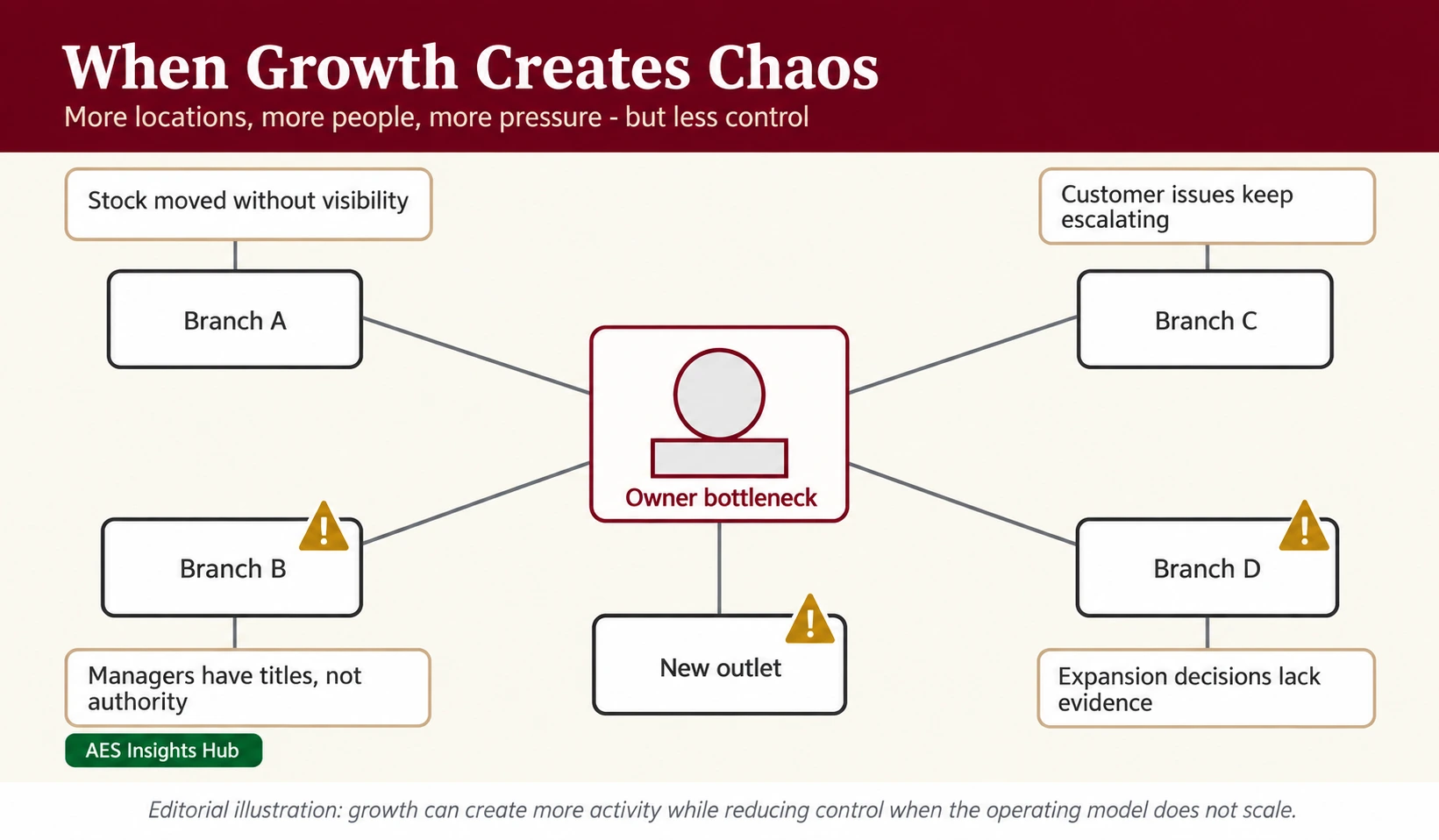
Inside the business, the feeling can be very different. Managers carry titles, but decisions still move around them. Employees know the owner personally, so instructions start to feel optional. Stock appears in one location and disappears from another. Customer complaints climb straight to the top. Meetings happen, but they circle around personalities instead of performance.
This is how growth begins to create chaos .
A real-world observation
In one field-based observation, a multi-location business sold products and offered professional services from several small work sites. The model looked sensible at first. The rental costs were manageable, teams were small, customers walked in, and money came through the business often enough to make growth feel natural.
But the reality under the surface was not as organized as it looked.
Employees had become so familiar with the director that instructions were often taken casually. Managers existed, but their authority was fragile. A staff member could receive an instruction from a manager, then call the director to confirm whether it should really be followed. Once that behavior became normal, the chain of command stopped being a structure and became a suggestion.

Customer complaints were handled in the same way. Instead of a clear complaint-resolution process, most issues had to reach the director. This looked like hands-on leadership, but it created delay, inconsistency and reputational risk, especially where service quality problems required calm, documented follow-up.
Stock movement was also informal. Items could be moved from one location to another without the people responsible for the branch having proper visibility. Restocking happened by instinct rather than by clear sales patterns, branch demand, minimum stock levels or recorded customer needs.
Then came expansion. New locations were opened with limited shared planning, weak evidence of demand, unclear marketing support and no strong readiness test. On paper, it looked like growth. In practice, the business had spread the same weaknesses across more locations.
The deeper lesson is important: the business did not only need more effort. It needed a stronger operating model.
That is the difference this article is focused on. Why Growing Businesses Become Inefficient – and Don’t Notice dealt with the quiet inefficiency that builds inside growing organizations. This article is about something different: the moment expansion increases pressure faster than leadership, governance and operating control can carry it.
In the shared observation, the problem was not simply poor effort.
People were working.
The owner was involved.
The business was active.
The deeper issue was that the business had grown beyond the structure that was supposed to hold it.
The early answer: Growth is a Control Test
When leaders describe chaos that usually accompanies growth, they often begin with people:
“Staff are not serious.”
“Managers are not strong.”
“Customers are demanding.”
“The branch is not performing.”
“The team does not follow instructions.”
Sometimes those descriptions contain part of the truth. But they can also hide the deeper issue.
A business can outgrow its control system. The company may have more sites, more staff, more stock movement, more customer issues and more cash passing through the operation, while still making decisions as if everything can be handled through the owner’s memory, mood and personal approval.
Why this is not just a local management issue
OECD’s 2025 work on SME scale-up notes that many scaling pathways involve investment in productivity, skills, internal capacity or operational transformation; it also identifies a relatively small group of “expansionist scalers” that grow without significant transformation before or during the growth phase.

It further emphasizes that sustainable scale is not only a matter of increasing output or employment; firms often need stronger internal capacity, and management capability to support growth [1]. The leadership lesson is simple: growth is healthier when you invest in how the business works, not only where the business operates.
So, the leadership question is not only, “Can we grow?” It is, “Can our decision system, cash controls, management rhythm and customer-service discipline carry the growth?”
Six control gaps that turn growth into chaos
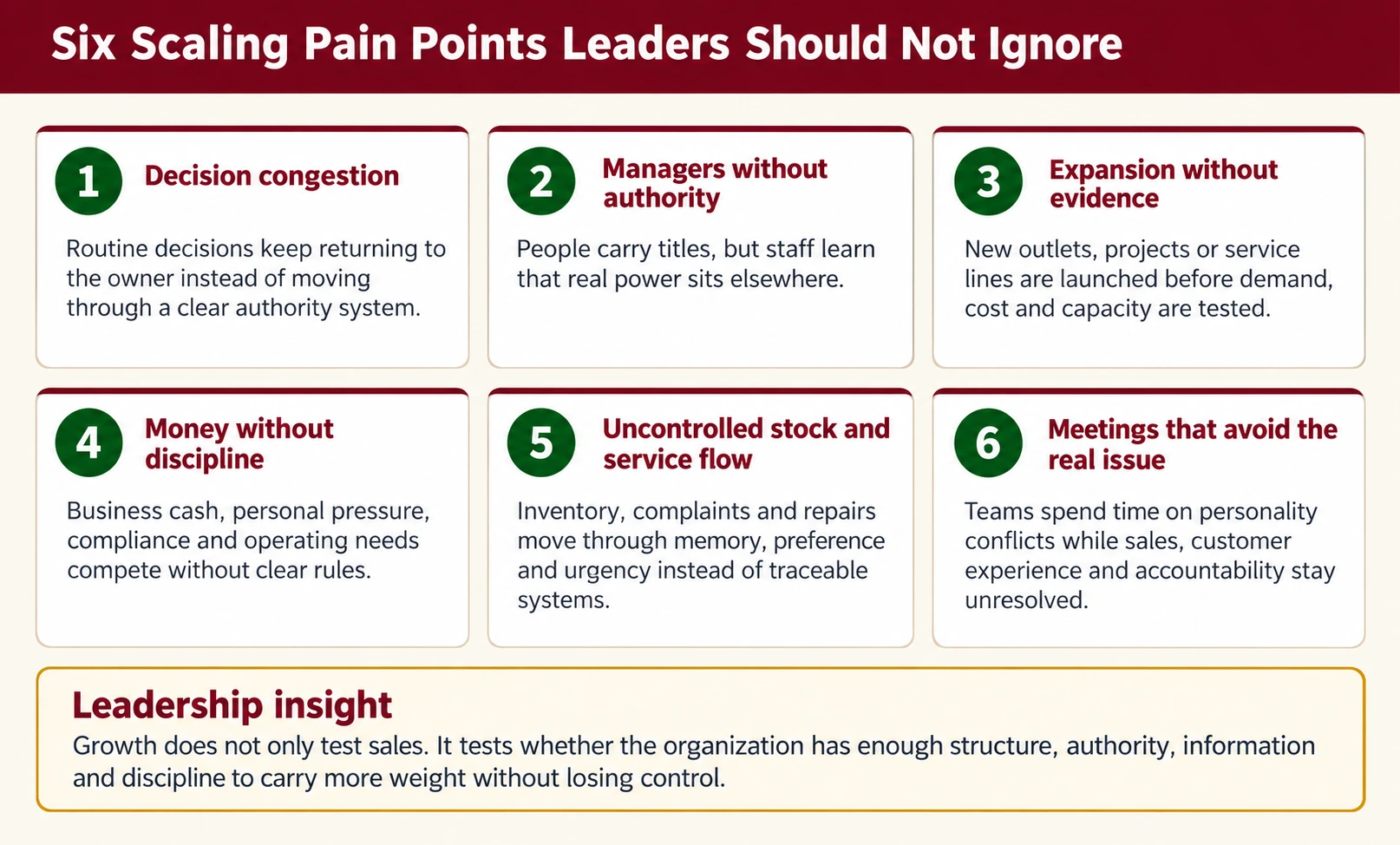
Visual guide: six control gaps that make growth unstable when expansion outruns the operating model.
1. Decision congestion: every road still leads back to the owner
In the early stage, owner involvement can protect quality. The owner knows the customer, approves discounts, handles complaints, watches stock and settles uncertainty quickly. But when every routine decision still returns to one person after the business has expanded, the owner stops being a leader of the system and becomes the system itself.
The cost is slow execution, dependent staff and decisions made according to availability rather than agreed standards. Customers wait. Managers hesitate. Employees learn that the safest move is to ask upward instead of thinking through the rule.
2. Titles without power: managers carry responsibility without authority
A manager who cannot make decisions is not managing; they are passing messages. When staff discover that any instruction can be confirmed or overturned by contacting the owner directly, the chain of command becomes optional.
This does not only frustrate managers. It weakens accountability. Employees stop responding to structure and start responding to proximity. The person closest to the owner appears more powerful than the person responsible for performance.
3. Branch economics without evidence: expansion happens before the case is clear
Opening another location, service line or project can feel like proof that the business is progressing. But expansion is not an automatic strategy. It becomes risky when leaders have not tested demand, foot traffic, staffing needs, fixed costs, marketing support, management capacity and break-even assumptions.
A new location does not correct weak discipline in the original operation. It multiplies it. If the first system cannot track stock, control cash, resolve complaints and manage people consistently, the next location gives those weaknesses more space to spread.

4. Cash discipline gaps: business money and personal pressure compete
As money starts flowing, a founder-led business can become vulnerable if business cash, personal spending, tax obligations, routine expenses and emergency needs are not separated clearly. The problem may not appear immediately because daily sales keep the organization moving.
Over time, the business begins to feel permanently underfunded even when activity is high. Marketing is postponed. Repairs or supplies are delayed. Compliance issues receive attention only when consequences become urgent. The business is busy, but it is not financially disciplined.
5. Traceability failure: stock, service issues and resources move without a dependable record
In a multi-location operation, stock movement is not a small administrative detail. It affects sales, cash flow, customer promises, branch performance, purchasing and trust between teams. When stock is moved by instruction, instinct or personal preference without consistent recording, the numbers stop telling the truth.
The same applies to complaints and service issues. If every problem depends on verbal updates and personal intervention, the business cannot learn from patterns. The complaint is handled as an event, not as evidence of what the system must fix.
6. A culture of exceptions: policies exist, but relationships decide practice
Contracts, policies and procedures create confidence only when people believe they will be applied consistently. When exceptions depend on favorites, fear, friendship or informal influence, staff learn the real system: relationships matter more than standards.
That is a governance risk, a people risk and an execution risk. It damages trust and makes performance difficult to manage because employees are no longer responding to the written rules. They are responding to what they believe leadership will tolerate today.
Why leaders often miss the warning signs
Growth is deceptive because it can make weak control look acceptable for longer than it should. In some cases, it completely masks the issue.
When customers are still coming in, leaders may treat complaints as isolated incidents.
When new sites open, visibility can be mistaken for strength.
When staff keep calling the owner, dependency can feel like loyalty.
When managers struggle, it can be easier to question their competence than to ask whether the business ever gave them real authority.
The danger is that movement feels like progress.
Stock is moving.
Staff are reporting.
Customers are visiting.
Meetings are happening.
But the business may still be losing control over standards, cash, accountability and customer trust.

PMI’s 2025 Pulse of the Profession report is useful here because it frames business acumen as the ability to move beyond tactical delivery and understand broader value, strategy and performance. The report also shows that professionals with high business acumen use more performance success factors than their peers, 9.1 compared with 6.3 [2].
In a scaling business, that means leaders should not ask only whether expansion is happening. They should ask whether expansion is creating reliable value without weakening the organization’s control.
The real cost of Growth Chaos
Growth chaos rarely appears as one big failure. More often, it leaks value through many small openings.
A branch opens but does not build enough customer flow.
Stock is bought but not aligned with demand.
Employees spend time navigating personality politics instead of improving service.
Managers disengage because their authority is repeatedly undermined.
Customer complaints damage reputation because there is no reliable resolution process.
Compliance is addressed only when pressure arrives.
Business cash supports personal needs while operational needs wait.
The cost is not only financial. It affects trust, execution speed, staff morale, customer confidence, governance discipline and the leader’s ability to make clear decisions.
A short Scaling-Control Self-Check
Use these questions before opening another branch, adding a new service, expanding headcount or funding a new growth move:
Can managers make routine decisions without informal reversal from the owner?
Can each location explain its sales, costs, stock position, customer issues and staffing needs using reliable information?
Can customer complaints be handled through a defined process before they become reputation problems?
Is business cash separated from personal spending, tax obligations and emergency withdrawals?
Are contracts, policies and HR standards applied even when they affect people close to leadership?
Does leadership review real operating measures, or do meetings drift into personalities and side issues?
Before expansion, does the business prepare a simple case covering demand, costs, staffing, marketing, risks and break-even assumptions?
Can leadership see reliable performance information rather than stories, impressions or loyalty?
Several weak answers do not automatically mean the business should stop growing, or that the issue may be one department or person. They do suggest that growth is outrunning control.
The Leadership Insight
The most important shift is this: expansion is not only a sales decision. It is a governance decision.
A leader can personally hold a small business together. They can remember the stock, approve the discount, discipline the employee, settle the customer complaint and decide where money goes. But once the business becomes larger than one person’s direct attention, personal control becomes too fragile.
The leader’s role must move from personal rescue to designed control.
Personal rescue says, “Call me when there is a problem.”
Designed control says, “Here is the decision limit, here is who owns the issue, here is how it is recorded, here is the escalation rule and here is how we review whether it improved.”
That is not bureaucracy. It is how a business protects trust while becoming bigger.

Another thing to note is that many businesses do not become chaotic because the owner is absent. They become chaotic because the owner is too present in the wrong decisions. That is a difficult but important distinction. The leader’s role is not to disappear. It is to create a business where leadership produces clarity, not dependency.
At a certain stage, the owner must stop being the unofficial stock controller, complaint desk, HR exception-maker, policy interpreter, finance gatekeeper and branch manager. The work of leadership becomes designing the system that helps other people make the right decisions without waiting for personal approval.
A structured improvement path
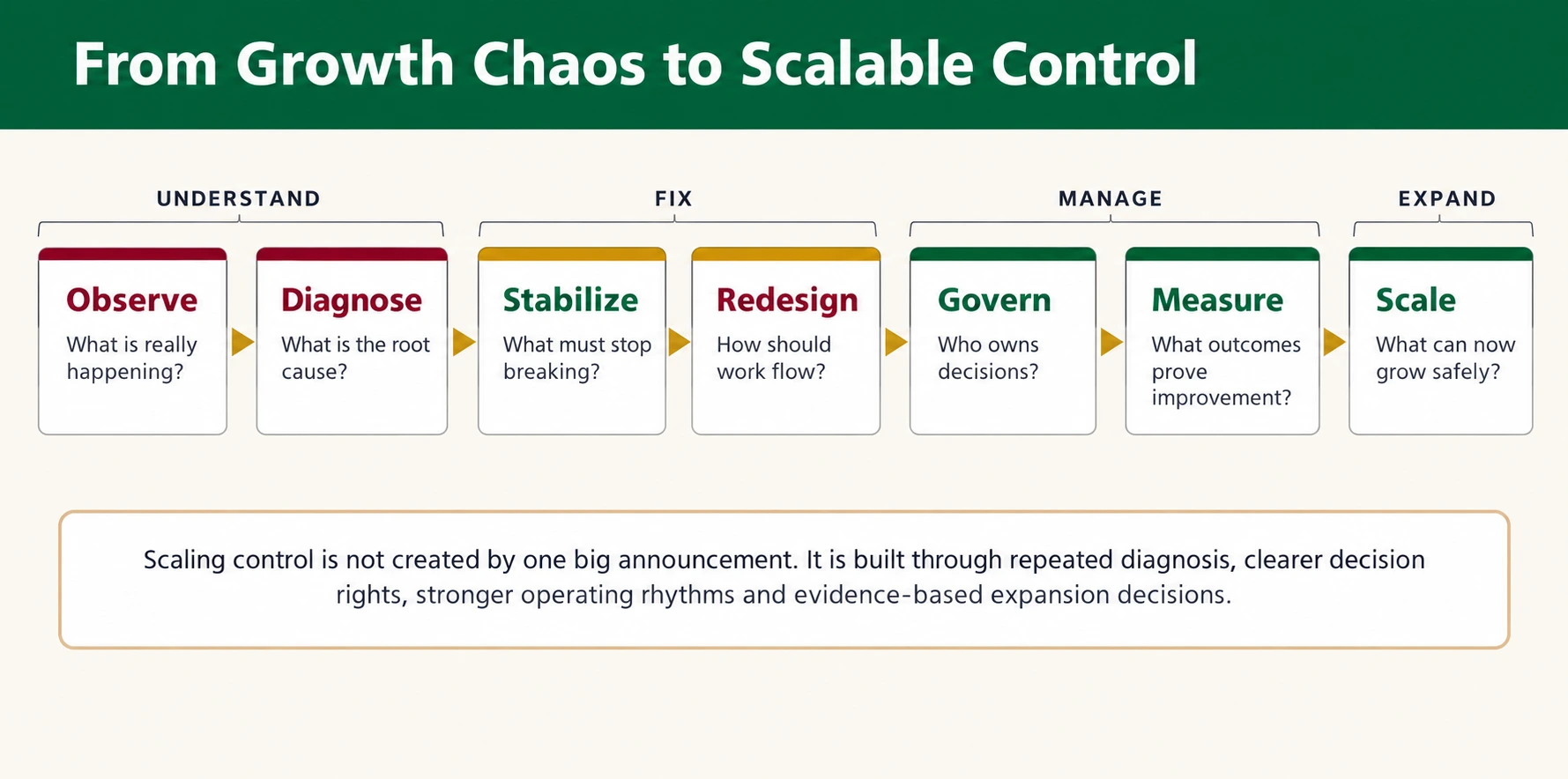
Improvement pathway: diagnose the control system before placing more pressure on it.
- Pause non-essential expansion decisions until the current operating model is understood. This does not mean stop growing forever; it means stop adding pressure blindly.
- Map the real flow of decisions, cash, stock, customer complaints and staff instructions. Do not map what the policy says. Map what actually happens.
- Separate owner-only decisions from management decisions. Define what branch managers, finance, supervisors and frontline employees can decide without informal reversal.
- Create branch-level visibility. Track simple measures such as sales, stock accuracy, customer complaints, cash variances, staff issues and completed actions.
- Restore policy discipline. Contracts, pay rules, customer-service procedures, stock controls and compliance obligations should not depend on mood, closeness or urgency.
- Change the meeting agenda. Replace personality-driven meetings with operating reviews: what changed, what broke, what the data says, who owns the next action and when it will be checked.
- Require a business case before the next growth move. Every new site, project or service line should have assumptions that can be reviewed, challenged and measured.
- Recruit qualified talent across key functions responsible for operational oversight and regulatory standards. Poor hiring decisions create expenses just as severe as fragile operating frameworks.
What Leaders should Avoid
Leaders should avoid treating every problem as an issue of staff attitude. While individual behavior matters, repeated patterns of behavior often point to deeper issues within the system people are working in.
Avoid opening new locations to escape problems in existing ones. Expansion magnifies weak systems. It does not repair them.
They should avoid bypassing their own managers and then blaming those managers for failing to lead. Authority cannot be delegated in words and withdrawn in practice.
Avoid outsourcing the thinking that internal managers have already raised. External help can be valuable, but it should not become a substitute for listening to evidence inside the business.
Avoid treating loyalty as a management system. Loyalty matters, but it cannot replace clear authority, records, standards and fair accountability.
Avoid delaying compliance until consequences arrive. Tax, contracts, employment obligations and financial controls are part of the cost of being serious.
Avoid using meetings to process personal tension while operational issues remain unresolved. Meetings should protect the business, not distract from it.
AES Perspective
At AES, we view scaling chaos as a business-system issue. The starting point is not to blame people harder, but to understand where control is breaking.
A practical review would examine decision rights, branch economics, financial discipline, management authority, stock movement, customer issue handling, policy enforcement and the evidence behind expansion decisions.

AES Business Consulting is positioned to support organizations with process audits, process optimization, compliance support, project and change management, strategic planning and performance improvement support [3]. AES consultations also begin by understanding the problem and context before forcing a solution path [4].
For leaders feeling the pressure of growth, the next step is not to become more involved in every detail. It is to design a business that no longer depends on informal involvement for every important decision.

What to do next
Use the AES Scaling Readiness Scorecard to assess whether your business has the decision rights, branch visibility, financial controls, management rhythm and governance discipline needed to grow without creating chaos.
For organizations that need a deeper review, AES can support a practical business diagnostic that helps leadership identify what is breaking, what should be redesigned and what must be strengthened before the next stage of growth.
Request Consultation
Questions Leaders Ask
What is growth chaos in business?
Growth chaos happens when a business expands faster than its systems, decision rights, reporting, financial controls and management capacity can support.
Is growth chaos always a sign that the business should stop expanding?
No. It means leadership should examine whether the current operating model can carry more pressure. Expansion may still be right, but it should be supported by evidence, controls and management capacity.
How is this different from ordinary inefficiency?
Ordinary inefficiency often shows up as wasted time or slow processes. Scaling chaos is broader: the business is adding locations, people or service lines while decision rights, cash discipline, policy enforcement and management authority remain weak.
Is opening a new branch always a good sign of growth?
No. A new branch is also a new cost and control responsibility. It should be supported by evidence, cash-flow planning, location analysis, staff readiness and operating discipline.
How do I know if my business is scaling too fast?
Warning signs include constant owner intervention, weak branch visibility, cash pressure despite sales, inconsistent service, poor stock control and managers who lack real authority.
Should the owner step back completely?
Not immediately. The owner should move from personal intervention to designed control. The goal is not absence; it is clarity about which decisions need executive involvement and which should be handled by managers or agreed rules.
Can a small business use this approach?
Yes. The aim is not corporate bureaucracy. It is simple control appropriate to the size and risk of the business: clear roles, reliable records, routine reviews and consistent standards.
What should leaders fix before expanding further?
Start with decision rights, financial discipline, branch performance reporting, stock visibility, customer issue handling, compliance rhythm and management authority.
When should leaders bring in outside support?
Outside support is useful when leaders are too close to the problem, when internal recommendations keep being dismissed or when expansion decisions carry significant financial, operational or governance risk.
Sources
[2] Project Management Institute. Pulse of the Profession 2025: Boosting Business Acumen. 2025.
[3] AscendEdge Solutions. Business Consulting Services.
[4] AscendEdge Solutions. Business Consultation / Start with the Problem.
Related Articles:
5 Signs Your Operations Need Re-Engineering, Not Just Optimization (In Business Today)
The Scaling Checklist: Is Your Business Ready to Grow? (In Business Today)
Case Study: Turning Chaos into Structure (In Business Today)
How Workload Imbalance Creates Quiet Resentment (The People & Culture)