
Growth can hide weak processes, unclear ownership and costly workarounds. This practical guide explains the five efficiency killers, why leaders miss them and how to build systems that support sustainable scaling.
Consider a growing distribution business. At 8:15 on a Monday morning, the owner is already dealing with three problems.
A customer was promised a delivery that the warehouse cannot confirm. Finance has prepared an invoice using quantities from an older spreadsheet. A manager is waiting for the owner to approve a routine purchase because nobody is sure where their authority begins and ends. By lunchtime, the customer has called twice, the warehouse team has checked the same stock three times, and several people have joined a meeting to work out what happened. Everyone is busy. Everyone is trying to help. The issue is eventually resolved.
Then the team moves on, relieved that the crisis is over.
Growth did not create one dramatic failure. It quietly made old ways of working too small for the business.
In the early days, the owner and a small team could manage orders, stock, deliveries, and customer follow-up informally. They knew the regular customers. They knew which products moved quickly. They could check stock by calling one person in the warehouse.
Then the business grew. More salespeople joined. More customers were added. Stock moved faster. The finance team needed cleaner records. Customers expected faster updates. But the process did not grow at the same pace.
Sales staff sometimes promised items before stock was confirmed. Warehouse updates came late. Accounts issued invoices based on information from different sources. Delivery follow-ups lived in phone calls and messages. When a customer complained, everyone worked hard to fix the issue, but nobody could easily see where the process had failed.
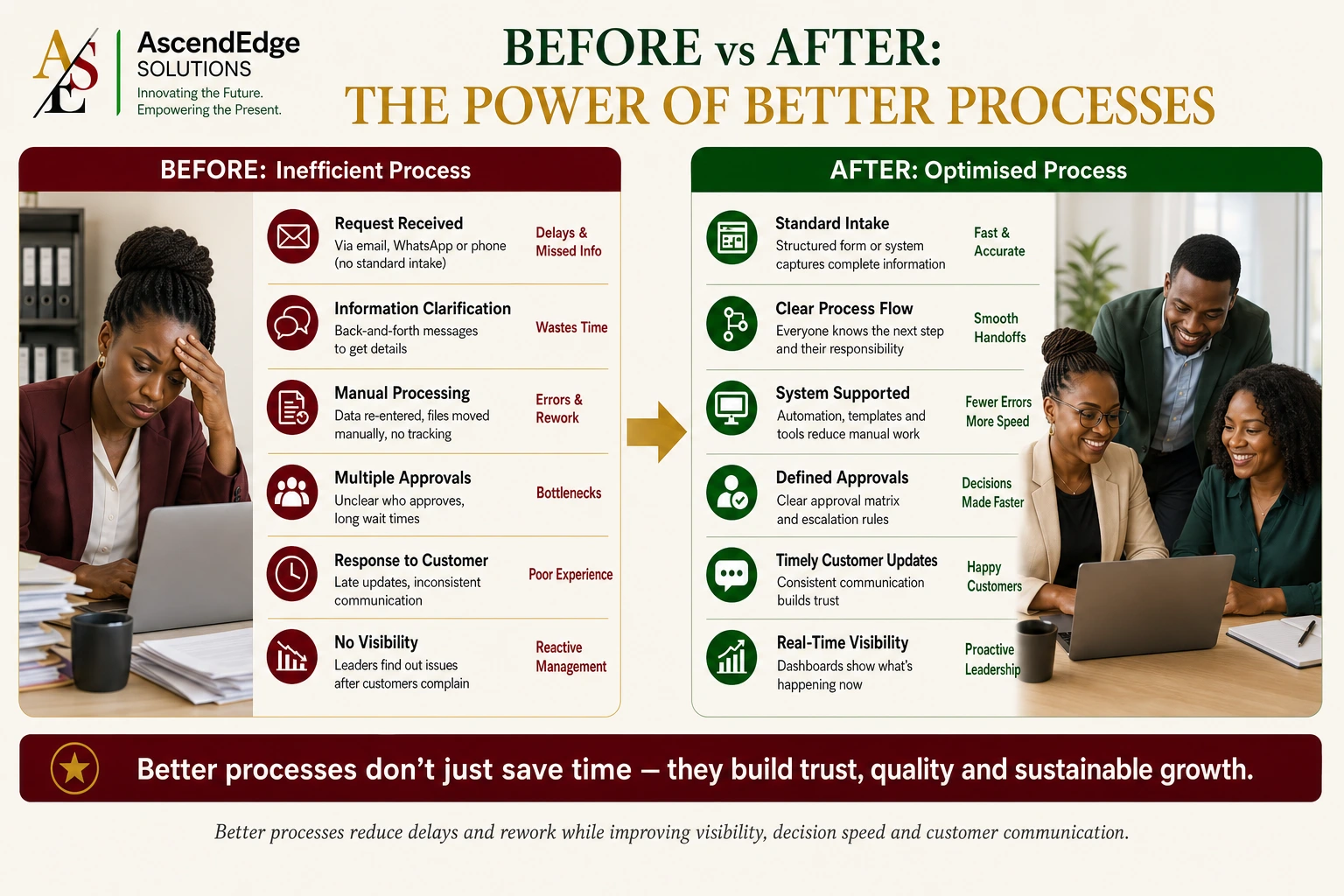
The problem was not that people were lazy. The problem was that the business had grown beyond its operating discipline. It needed clearer stock controls, defined handovers, customer communication standards, daily visibility, and a simple management rhythm that showed problems before customers felt them.
This example is not limited to distributors. The same pattern can appear in a school handling admissions, an NGO managing field reports, a clinic managing patient files, a professional services firm tracking client deliverables, or a family business trying to open a second branch. Growth exposes the weaknesses that small size used to hide.
The business has grown, but the way work moves through it has not.
A business owner can feel proud and worried at the same time.
This composite scenario reflects a familiar pattern in growing SMEs, NGOs, schools, professional firms, family businesses and institutional departments. Revenue, customers, programmes, staff or branches increase, yet simple decisions take longer. Staff keep asking the same questions. Reports arrive late. Customers follow up on issues that should have been closed already. The owner is still copied into everything because people are afraid to make decisions without them.
From the outside, the organization looks successful. Inside, people quietly say: "We are bigger now, but somehow everything is harder."
The result is not always immediate failure. At first, it simply feels like pressure. Over time, it becomes inefficiency.
Growth does not create inefficiency. It exposes what small size used to hide.
When a business is small, informal coordination can be a strength. The founder remembers the important customers. A trusted employee knows which supplier to call. Team members can ask questions across the room. A spreadsheet, notebook or WhatsApp group may be enough to keep everyone aligned.
Those methods are not automatically wrong. They simply have a limited capacity.
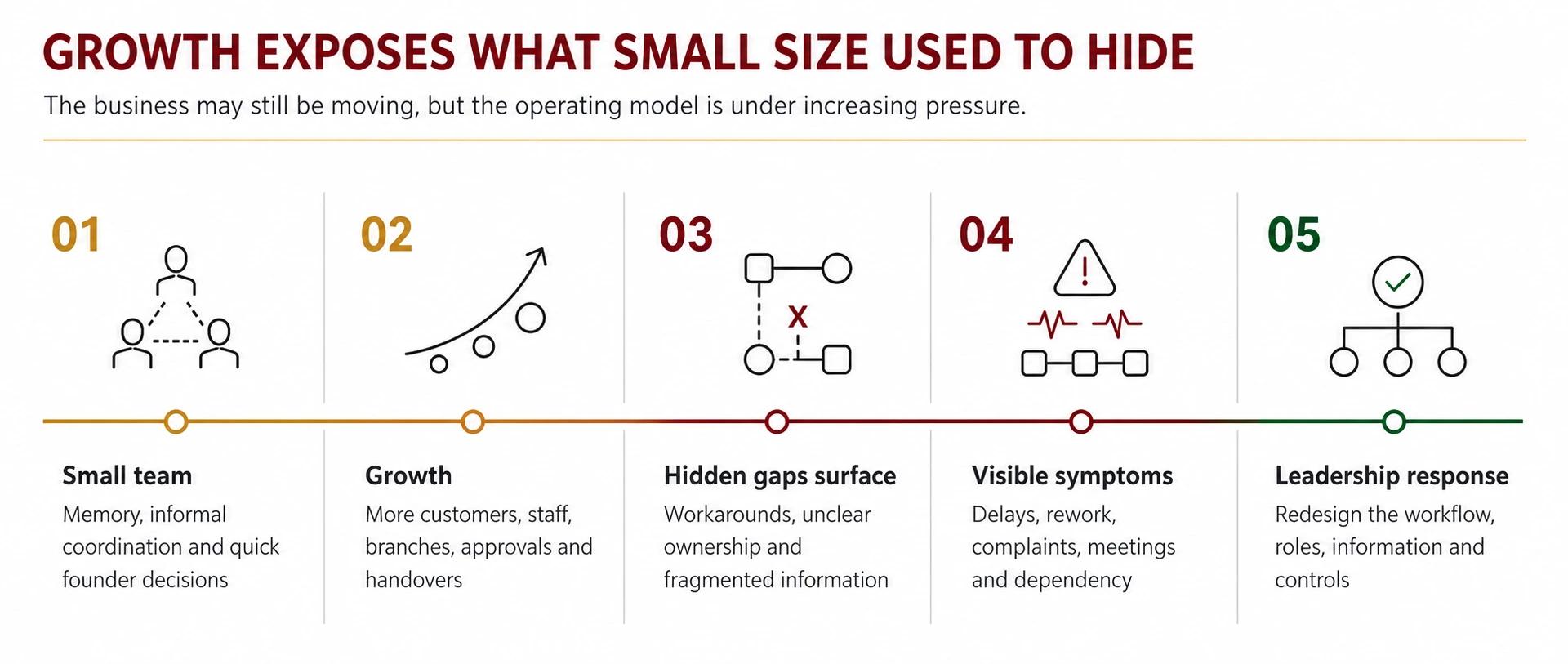
Growth adds more than volume, it changes the rules. It adds handovers, exceptions, approvals, reporting needs, customer promises and dependencies between people. A process that worked with five people may become unreliable with twenty-five. A decision the founder once made in two minutes may now sit between three departments. Information that lived comfortably in one person's head becomes a business risk when several people need it.
More customers mean more promises to track. More employees mean more handovers. More products or services mean more exceptions. More branches, donors, parents, suppliers, or clients mean more reporting pressure. What used to be simple coordination becomes a system problem.
Many leaders miss this because the business is still moving. Customers are still buying. Staff are still working hard. Revenue may still be improving. So the inefficiency hides behind activity.
The central problem is not a lack of effort.
In many cases, people are working harder than ever. The problem is that effort is compensating for an operating model that has not matured with the organization.
What leaders see - and what may actually be happening
What Leadership Sees | What may be happening underneath |
|---|---|
The team needs to communicate better. | The workflow has unclear handovers, owners, and escalation rules. |
We need more employees. | Skilled people are spending time on duplication, waiting, rework, and manual reconciliation. |
Managers need to take more responsibility. | Decision rights and approval limits have never been clearly defined. |
We need new software. | The underlying process is unclear, inconsistent, or designed around workarounds. |
People are always busy. | Activity is increasing faster than useful output, service quality, or management visibility. |
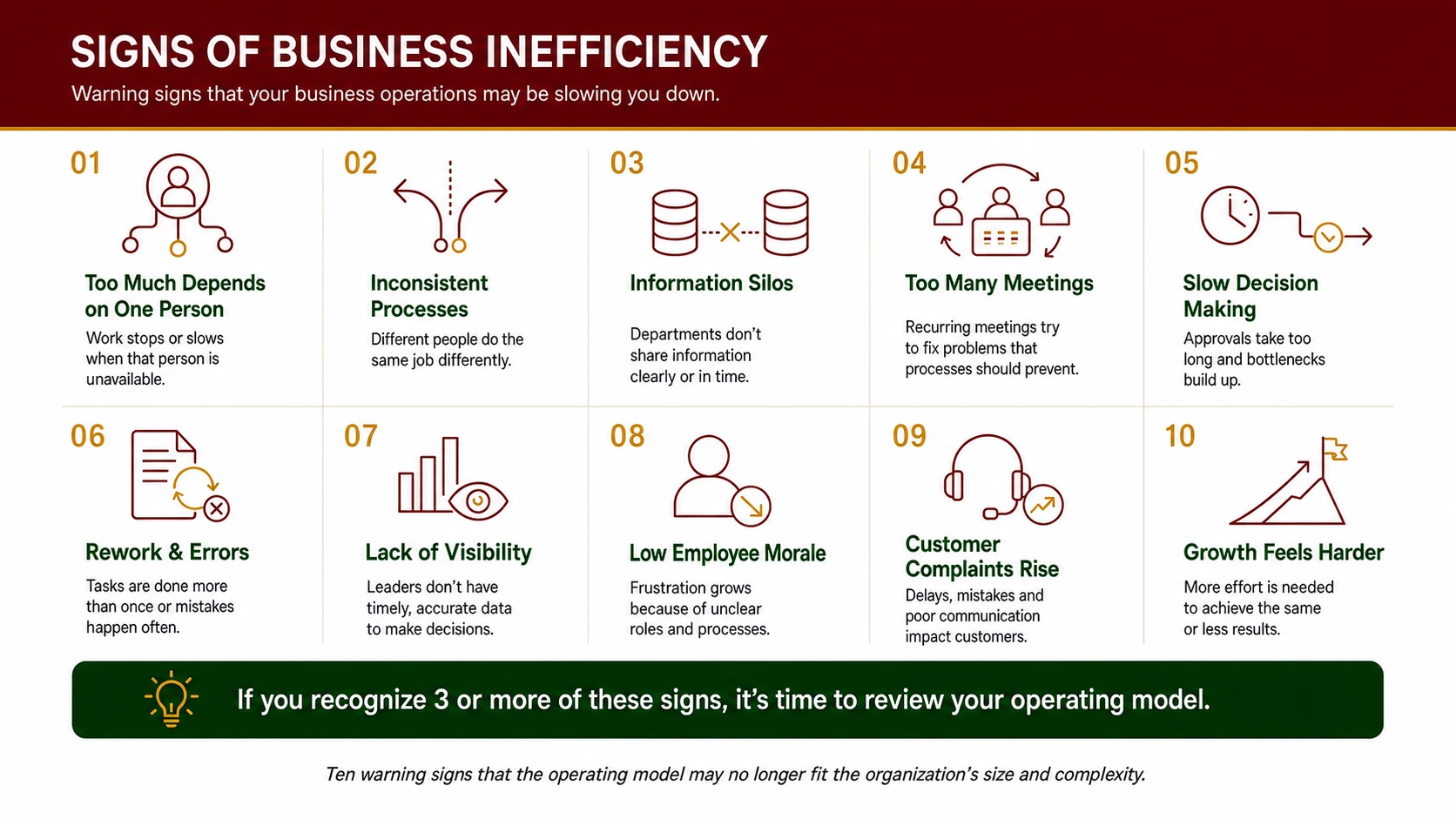
The five efficiency killers growing businesses often miss
1. Hero dependency
Every growing organization has people who "just know how things work." They remember the customer history, reconcile the records, rescue difficult projects, manage the key relationship or understand the reporting requirement nobody else can explain.
At first, this looks like strong performance. Over time, it becomes a single point of failure. When the person is absent, promoted, overloaded or leaves, work slows because the knowledge belongs to an individual rather than the organization.
What leaders notice: one person is indispensable. What may be happening underneath: the business has not documented, shared or backed up critical knowledge.
Ask: If this person were unavailable for two weeks, what would become confused or stop?
That is where documentation, backup roles, and handover discipline are needed.
2. The process gap
Many growing businesses continue to run important activities through habits instead of defined processes. In small teams, people often learn by watching, asking and copying. Purchases happen when stock looks low. Complaints go to whoever answers first. New employees are told to "follow what the others do."
As volume grows, different people begin performing the same work in different ways. One branch records information carefully; another keeps it in messages. One manager approves immediately; another asks for several extra steps. Mistakes are blamed on individuals even though the organization has never defined one reliable method.
What leaders notice: inconsistent performance.
What may be happening underneath: people are being held accountable for a process that has never been made clear.
Ask: Could a capable new employee complete this task correctly without relying on verbal instructions?
3. The information silo
A growing business can have a lot of information and still lack visibility. When information does not flow, teams make decisions from partial reality. Sales knows what was promised to the customer. Operations knows what can actually be delivered. Finance knows what has been paid. Managers may think a project is on track because no one has escalated the delay. HR knows where capacity is stretched. Management sees a summary after the problem has already travelled through the business. But the full picture sits in different places.
Each team holds a piece of the truth, but no one can see the whole picture early enough to act. The result is repeated data entry, conflicting updates, late reports and meetings where people discover that they have been working from different assumptions.
What leaders notice: communication problems.
What may be happening underneath: the organization has no dependable source of shared operational truth.
Ask: Can the people making a decision see the same current information at the same time?
4. Meeting multiplication
Meetings often increase when a business grows. At first, that feels professional. There is a sales meeting, an operations meeting, a project meeting, a management meeting and several follow-ups after the meetings.
Meetings are not the enemy. The warning sign is when meetings exist because ownership, decision rights or information flows are unclear. If every routine decision requires a room full of people, the meeting is carrying work that the operating system should be doing, and if every meeting repeats the same problem, the team may be discussing symptoms without fixing the system behind them.
What leaders notice: people need to communicate more.
What may be happening underneath: teams are repeatedly coordinating around unclear processes instead of correcting them.
Ask: What decision rule, report or handover would make this meeting shorter or unnecessary?
5. The "we have always done it this way" trap
Some processes worked well when the business was smaller. That does not mean they will work at the next stage. A manual payment reconciliation, a handwritten stock book, shared spreadsheet, WhatsApp approval or founder sign-off may work perfectly at one stage. Under growth, it becomes a source of errors, delays, and dependency. This trap is common because familiar processes feel safe. People trust what they know, even when it is no longer serving the business.
The organization then adds people around the old method instead of redesigning the method itself. More staff perform more checking, follow-up and reconciliation, while the core process remains fragile.
What leaders notice: pressure caused by growth.
What may be happening underneath: yesterday's method has become today's bottleneck.
Ask: If we designed this process for our current size today, would we still build it this way?
Why leaders often do not notice early enough
Leaders are not blind. They are busy. They are handling customers, cash flow, staff issues, supplier pressure, projects, board expectations, donor requirements, or expansion plans. Intelligent, committed leaders can miss inefficiency because it does not arrive as one dramatic breakdown. It develops through many small inconveniences that the organization learns to tolerate.
Revenue can mask it. When sales or funding is rising, leaders may assume the business is healthy. The business can afford the overtime, rework, emergency deliveries and additional staff used to keep weak processes moving because the pain feels manageable.
Hardworking employees can mask it. They create private trackers, remember missing steps, stay late and rescue work before leaders see the failure. Their commitment keeps the organization functioning and is admirable, some employees are even rewarded for it. But it can also hide the real cost of weak systems.
Fragmented information can mask it. By the time inefficiency becomes obvious, it may already be affecting the business. Finance sees rising costs. Operations sees delays. HR sees fatigue. Customers experience inconsistency. The owner sees growth. Because each person sees only one part, nobody names the pattern.
Most importantly, the decline is gradual. Today's extra phone call becomes next month's regular workaround. The workaround becomes an accepted habit. The habit eventually becomes "how we do things here."
The real cost is more than wasted time
Inefficiency is expensive because it multiplies. It rarely sits neatly in one line of the financial statements. One unclear handover causes a delay. The delay creates a customer complaint. The complaint requires a manager to intervene. The intervention interrupts another priority. The team then holds a meeting to discuss the same issue, but the process remains unchanged.

Staff lose confidence when priorities keep changing. Customers lose patience when service becomes inconsistent. Managers lose credibility when reports are late or unreliable. The owner loses strategic time because too much energy goes into chasing routine issues.
The financial cost may show up as overtime, emergency purchases, duplicated work, stock discrepancies, delayed collections, missed opportunities, or unnecessary hiring. But the non-financial cost can be just as serious.
The cost compounds because every workaround creates another handover, another check or another dependency.
In many growing organizations, inefficiency first appears as busyness. Later, it becomes a constraint on growth.
A practical diagnostic: run this review this week
Leaders do not need to wait for a crisis before reviewing efficiency. Use the following questions in your next management meeting. They are not a formal audit, but several concerning answers may indicate that the issue is structural rather than isolated.
Diagnostic question | What a concerning answer may reveal |
|---|---|
Can routine customer or operational decisions move without the owner becoming involved? | Decision rights may be unclear or too centralized. |
Can a new employee perform a core task using documented guidance? | Critical work may live in people rather than systems. |
Can management produce reliable operational information quickly? | Data may be fragmented, duplicated or late. |
Do teams repeatedly correct the same mistakes or handle the same complaints? | The organization may be treating symptoms without changing the process. |
Are senior employees spending significant time on routine follow-up or rework? | High-value capacity may be consumed by preventable coordination. |
Do departments regularly discover conflicting promises, priorities or figures? | Handover and information systems may be weak. |
If workload doubled in the next six months, which process would break first? | The answer identifies a likely scaling constraint. |
Which process causes the most complaints, delays, rework, or follow-ups? | A high-impact process may be poorly designed, inconsistently followed, or inadequately supported. |
Where are staff using WhatsApp, notebooks, private spreadsheets, or memory because the formal system is not trusted? | Official systems may be impractical, incomplete, outdated, or disconnected from how work is actually performed. |
Which approval takes longer than it should, and why? | Approval levels may be excessive, accountability unclear, or decision-making unnecessarily centralized. |
Where do teams enter or reconcile the same information more than once? | Processes may contain duplicated effort, disconnected systems, and a higher risk of errors or inconsistent records. |
Which reports arrive too late to influence decisions? | Reporting processes may be overly manual, poorly defined, or focused on historical activity rather than timely management action. |
The answers will usually reveal that inefficiency is not one big problem. It is a pattern of small gaps: unclear processes, weak visibility, missing controls, dependency on individuals, undertrained supervisors, poor system use, and management routines that no longer match the size of the organization.
The leadership insight: scaling is not carrying more
Leaders do not scale an organization by personally absorbing more decisions, more follow-ups and more exceptions. They scale it by reducing how much the organization depends on individual memory, heroic effort and constant intervention.

That requires a shift in leadership work. The founder or manager moves from being the person who always solves the problem to the person who improves how problems are prevented, seen and resolved.
This does not mean becoming distant or bureaucratic. It means creating clear decision rights, reliable information, practical controls and capable managers so routine work can move without unnecessary escalation.
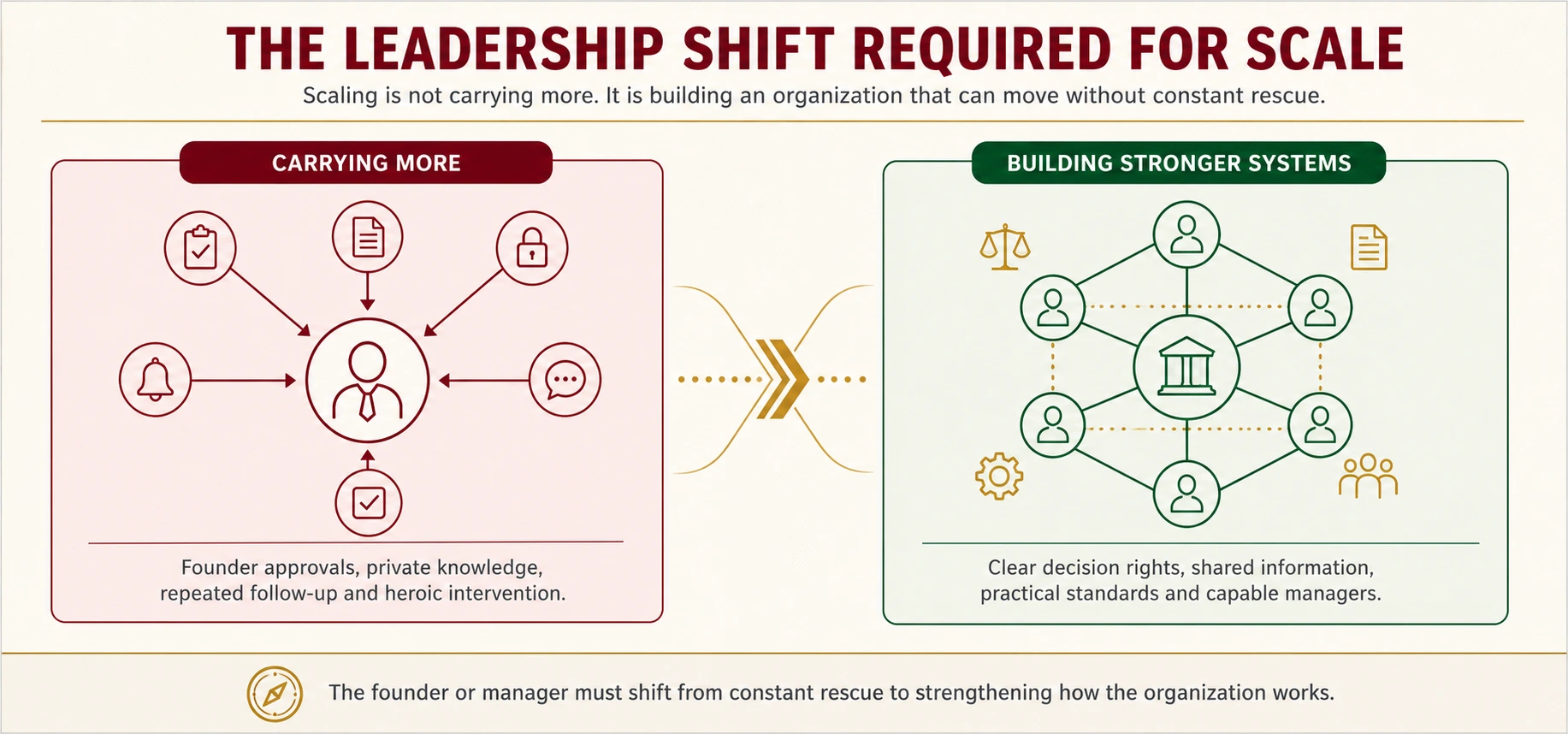
Effort can rescue a weak system for a while. It cannot make the system scalable.
What successful scaling actually requires
The businesses that scale well do not only add more people, more tools, or more branches. They build a stronger operating model. That does not mean creating unnecessary bureaucracy. It means making good work repeatable.

- Document before delegating. Critical work must exist outside one person's memory. New employees need clear steps, examples, templates, and escalation paths. Documentation should be clear enough to guide action, not merely satisfy a filing requirement.
- Standardize before you digitize. Technology can accelerate a clear process, but it can also accelerate confusion. Software can support efficiency, but it cannot fix a process that no one understands. Agree on the workflow and information requirements before selecting the tool.
- Clarify ownership before demanding accountability. People need to know the outcome they own, the authority they have, the standard expected and when to escalate.
- Build visibility across handovers. The status of important work should be visible before a customer, donor, parent, supplier or executive has to ask.
- Measure flow, not only activity. Do not only ask whether people are busy. Track turnaround time, error rates, unresolved issues, rework, handover delays, and dependency risks.
- Review the operating model at each growth stage. New branches, services, staff levels, systems or reporting obligations should trigger a review of what may no longer fit.
The AES CLEAR Growth Efficiency Review
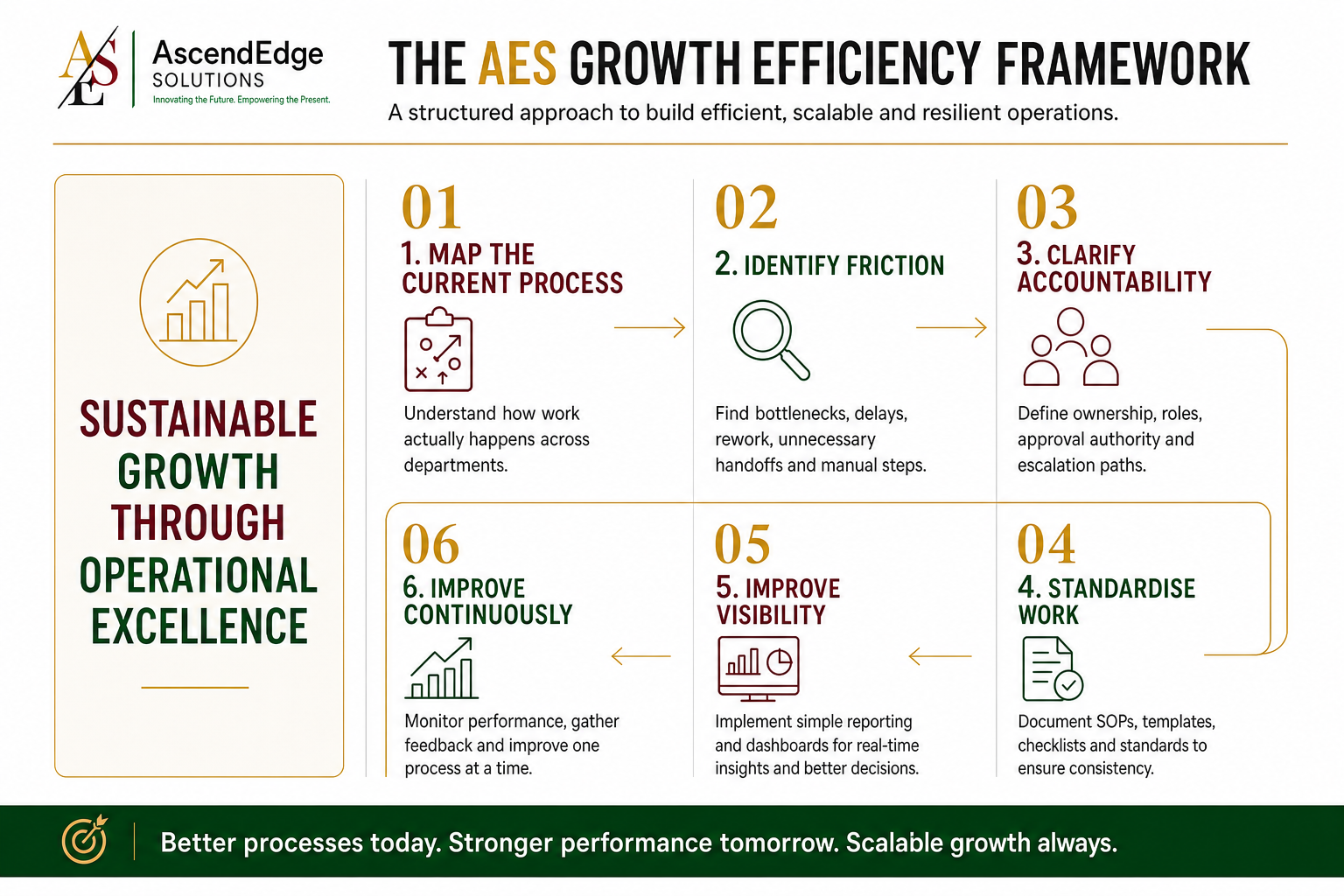
A practical response does not begin with fixing everything at once. It begins with one important process and a disciplined review of how the work actually moves. This is a simple structure leaders can use before hiring more staff, buying a new system, or blaming the team.
Step | Focus | Practical Question |
|---|---|---|
C - Capture the real workflow | Follow the work from request to result, including informal calls, messages, checks, waiting, and rework. | What actually happens, not what the policy or organogram suggests? |
L - Locate friction and dependency | Identify bottlenecks, repeated entry, unclear handovers, single-person knowledge, and unnecessary approvals. | Where does the process slow down, become uncertain, or depend on rescue? |
E - Establish ownership and decision rights | Define the result owner, supporting roles, backup, approval limits, and escalation conditions. | Who owns the outcome, and what can they decide without waiting? |
A - Align information, tools, and standards | Create one trusted source of information and simple templates, checklists, naming rules, or system requirements. | Do people have the same information, standard, and tool at the right time? |
R - Review results and improve | Track a small set of measures such as turnaround time, rework, backlog, errors, complaints, or unresolved exceptions. | Is the process becoming easier, faster, more reliable, and less dependent on individuals? |
What leaders should avoid
Common reaction | Why it often underperforms | Better question |
|---|---|---|
Hire more people around the problem | New staff inherit the same unclear workflow and add more handovers. | What work should be removed, clarified or redesigned first? |
Buy software before understanding the process | The tool may digitize confusion or create another disconnected record. | What decision, workflow or visibility problem must the technology solve? |
Write long SOPs nobody uses | Documentation becomes a compliance exercise rather than a working guide. | What is the simplest standard people can follow and improve? |
Centralize every decision with the founder | The owner becomes the queue, and managers never develop judgement. | Which decisions can be delegated with clear limits and escalation rules? |
Blame employees for repeated failures | Individual correction does not repair the conditions producing the same error. | What in the system makes the mistake likely or hard to detect? |
Try to fix everything at once | The organization becomes overwhelmed and improvements are difficult to sustain. | Which process creates the greatest customer, cost or control risk now? |
The leadership insight: efficiency is a growth discipline

A growing business does not become efficient by accident. Efficiency is designed through clear processes, reliable information, practical controls, trained people, accountable managers, and review routines that keep work visible.
Efficient growth requires leaders to move beyond managing incidents. This does not mean losing flexibility. The goal is not to make a growing organization rigid. It is to protect the speed, judgment, and customer focus that made the business successful while reducing the confusion that comes with scale.
Every business eventually outgrows some of the methods that helped it begin. The organizations that continue growing are not the ones that demand endless effort from their people. They are the ones that recognize when effort is compensating for weak systems - and redesign the work before the strain becomes a limit.
A realistic way to begin
Do not try to redesign the entire organization in one exercise.
Start with one process that matters: customer onboarding, purchasing, stock movement, admissions, donor reporting, invoicing, project approvals or complaint handling.
Follow the work from beginning to end. Observe what actually happens, not only what the policy or organogram says should happen.
Note every handover, wait, repeated approval, workaround, information gap and point where one person must rescue the process.
Then choose the most important constraint. Clarify the outcome, remove unnecessary steps, define ownership and decision authority, create one reliable record, train the people involved and measure whether the change improves speed, quality or visibility.
Fix one important process well.
Learn from it. Then move to the next.
Sustainable efficiency is built through disciplined improvement, not a single dramatic intervention.
AES Perspective
At AscendEdge Solutions, we treat growing inefficiency as a systems question before treating it as a people or technology problem. A useful review examines how work flows, where decisions wait, what information people use, who owns each outcome, which controls add value and where employees are compensating for gaps.

The correct response may involve process redesign, clearer roles, practical SOPs, management routines, training, better information flow or carefully selected technology. The answer depends on the organization's size, sector, current systems and stage of growth.
If growth has made your organization busier but not more controlled, use the AES Business Efficiency Checklist based on your industry to identify where processes, responsibilities, information and approvals may be breaking down.
Organizations needing a deeper review can request an AES Operations and Process Diagnostic to map priorities and develop a practical improvement plan. A structured review can help you see whether the issue is people, processes, systems, accountability, visibility, or a combination of all five.

RECOMMENDED NEXT STEP
Download the AES Business Efficiency Checklist based on your industry and review one core process before your next management meeting. For a deeper view, request an Operations and Process Diagnostic through the business consultation page.
AES Business Consultation PageAES Efficiency Checklist for NGO-State-Owned-Enterprises v1.2 (free).pdf
AES Efficiency Checklist Completed Example.pdf
AES Efficiency Checklist for Corporate-Institutions v1.2 (free).pdf
AES Efficiency Checklist for Education-Health Institutions v1.2 (free).pdf
AES Efficiency Checklist for SMEs-MSMEs v1.2 (free).pdf
Share Article
Frequently asked questions
Here are some common questions businesses and companies ask.

Because customers, workload, staff and reporting needs often grow faster than processes, decision rights, information systems and management routines.
Not necessarily. Individual performance should be managed, but recurring problems across capable people often indicate unclear workflows, ownership, authority, information, tools, or standards.
Repeated follow-ups, late reports, duplicated work, unclear approvals, recurring complaints, dependence on key people and constant management intervention are common warning signs.
Not necessarily. Leaders should first examine whether delays come from workload, unclear workflow, unnecessary approvals, poor information or repeated rework. Hiring into a weak process can increase complexity.
Only after understanding the current workflow and defining the desired outcome. Automation can improve a clear process, but it may simply accelerate or hide a poorly designed one.
Start with a process that is customer-facing, mission-critical, repeatedly delayed, heavily dependent on one person, or frequently discussed in management meetings without a permanent fix.
Choose one important recurring process, observe what actually happens, identify the main bottleneck or dependency, redesign the flow, clarify ownership and measure whether the change improves performance.