
A digital project can be technically well delivered and still fail the organization. The decisive mistakes often happen before implementation: the problem is vague, value is undefined, requirements are incomplete, ownership is weak, data is not ready and users are treated as people to train later rather than partners in design. Readiness must be proved before delivery is approved.
Digital projects rarely begin failing on launch day. The warning signs usually appear earlier: an unclear business problem, weak ownership, incomplete requirements, unprepared data and users who were never involved.
This guide helps leaders test readiness before implementation begins.
The project had a budget. It had a vendor. It had a launch date.
What it did not have was clear agreements.
Finance believed the new platform would improve approval control. Operations expected it to remove repeated data entry. Senior management wanted real-time reports. The vendor had been shown a feature list, but nobody had mapped the current workflow from request to approval to reporting. Two departments used different definitions for the same records. The person named as project sponsor attended the first meeting and then delegated every decision.
By the time configuration was due to begin, the team was already arguing about scope, ownership and priorities. The software had not failed. Implementation had not even started. The project setup had failed first.
This scenario explains a common recurring project pattern.
Digital project failure often starts in the initiation stage
A digital project is any structured effort to introduce or materially change software, data, infrastructure, automation, cloud services, websites, platforms or technology-enabled workflows. Implementation is the stage where the selected solution is configured, built, integrated, migrated, tested and introduced into real work.
Before that comes initiation: defining the need, desired value, scope, ownership, requirements, risks, delivery approach and readiness. This stage may feel slower than buying a tool, but it is where the organization decides whether the project has a stable foundation.

The UK Infrastructure and Projects Authority describes its Project Routemap as an early intervention that helps sponsors understand the capabilities needed to set a project up for success.[1]
UNDP expresses the same discipline more simply in its Digital Standards: start with the need, test early and often, and form the right team.[2]
When those decisions are skipped, implementation becomes an expensive discovery exercise. The vendor starts asking questions the organization should already have answered. Every unanswered question becomes a delay, a change request, a compromise or a conflict.
The six failures that happen before delivery begins

1. The organization has a solution, but not a precise problem
“We need an ERP,” “we need an app,” or “we need to automate” are solution statements. They do not explain what must improve.
A useful project problem is concrete: monthly reporting requires days of manual reconciliation; student records are duplicated across departments; donor reports cannot be produced from one trusted dataset; customer requests are lost between email, WhatsApp and spreadsheets. The problem should lead to an outcome that can be measured.
UNDP warns that building something people do not need or cannot use is one of the greatest digital risks.[2] The project should therefore begin with user and business needs, not a vendor catalogue.
2. Vendor demonstrations become the requirements process
A polished demonstration can make a product feel like the answer before the organization has documented the question. Teams begin requesting features they saw on screen rather than defining what work, control, reporting and user needs the solution must support.
Requirements are not a feature wish list. They are documented statements of what the business and its users need, including security, reporting, performance, integration, access and transition needs. The Project Management Institute (PMI) guidance distinguishes business requirements, stakeholder requirements and solution requirements, with the technical solution defined only after the first two are understood.[3]
3. The sponsor owns the approval, but not the decisions
Some projects have a sponsor on the organization chart but no active owner in practice. The sponsor approves the budget, then leaves the project manager or IT team to settle competing departmental priorities.
A real sponsor protects the business case, resolves cross-functional conflicts, makes scope trade-offs, confirms priorities and holds process owners accountable. Without that authority, unresolved decisions are pushed into implementation, where they become more expensive.
4. The existing process has not been understood
Technology cannot reliably improve a process the organization has never observed end to end. Policies may describe one workflow while staff use another. Exceptions may be handled through calls, personal messages or private spreadsheets. Approvals may depend on informal influence rather than documented authority.
If the real workflow is not mapped, the new system will either copy a weak process or force users into a design that ignores legitimate operational realities. Both outcomes create workarounds.
5. Data and integration are treated as technical details
Data migration means moving existing records into the new solution. Integration means enabling systems to exchange information. Both depend on business decisions: which records are authoritative, what fields mean, who owns quality, what should be retained, who may access it and how errors will be corrected.
A project can be “on schedule” while the data is duplicated, incomplete or inconsistent. It can also select a good tool that cannot exchange information with critical finance, HR, inventory or reporting systems. These are not problems to discover during go-live week.
6. People are invited at training, not during design
When end users first see the solution during training, the project has delayed its most important usability test. Staff understand the exceptions, pressures and informal steps that are easy to miss in executive meetings.
Involving users does not mean every preference becomes a requirement. It means the project tests assumptions early, understands real work and builds credible adoption. A technically correct platform that people cannot use confidently will quickly produce shadow spreadsheets, off-system approvals and unreliable data.
What early failure costs the business
Pre-implementation gaps create more than schedule pressure. They affect business performance in several ways:
Budget leakage through repeated discovery, redesign, vendor change requests and extended subscriptions or support.
Operational disruption because teams must maintain old and new processes at the same time.
Weak controls when access rights, approvals, records and responsibilities are configured without clear governance.
Decision risk when leadership receives fast reports built on inconsistent definitions or poor-quality data.
Staff fatigue and resistance after users are blamed for rejecting a solution that did not reflect their work.
Loss of confidence among boards, donors, customers and employees when promised improvements do not materialize.
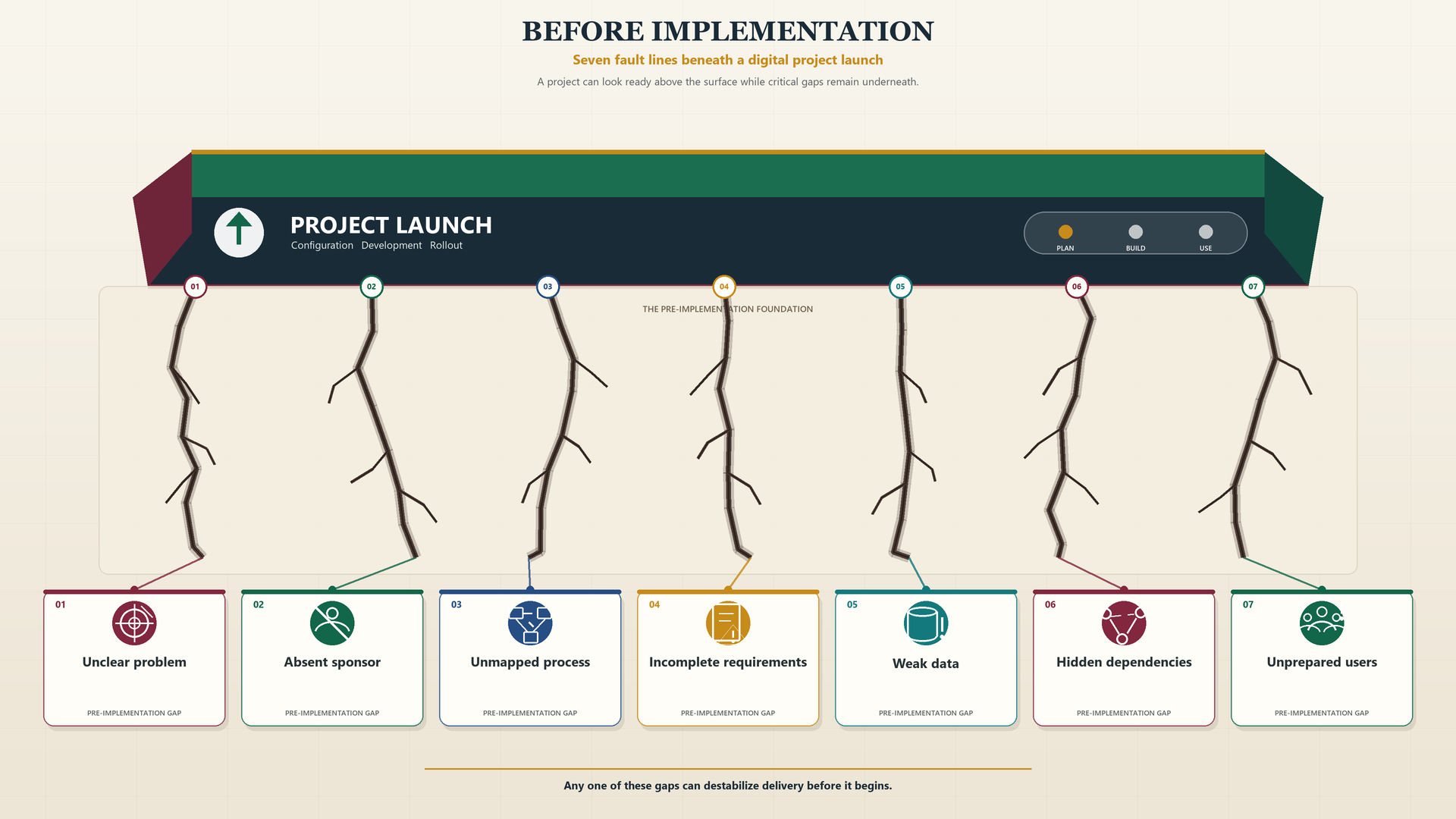
PMI’s current project-success research emphasizes value that justifies the effort and expense, rather than treating time, cost and scope as the only measures.[4]
A project that goes live but does not improve the intended business outcome has not delivered the value that justified it.
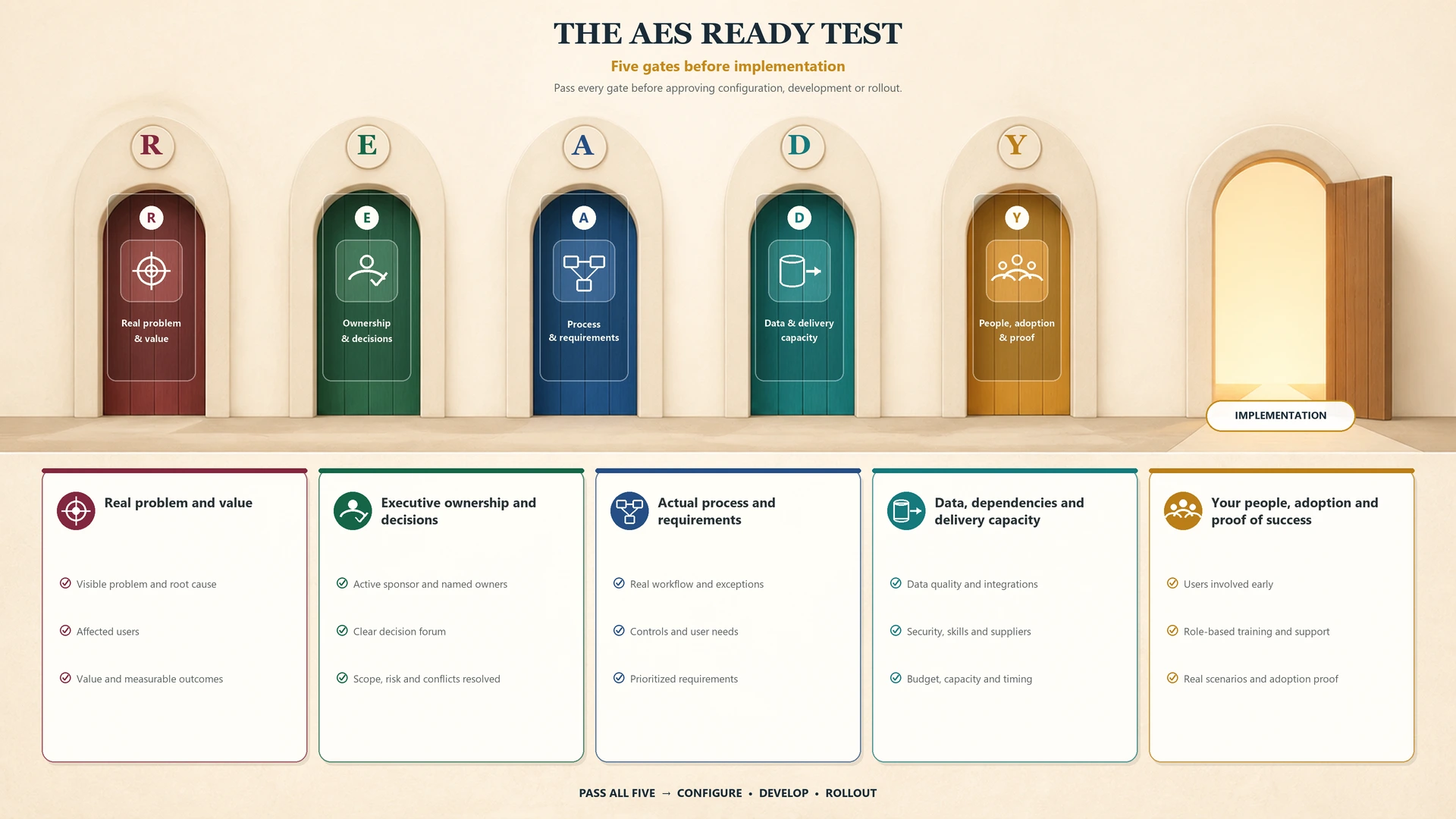
The AES R.E.A.D.Y test: five gates before implementation
Before approving configuration, development or rollout, leadership should be able to pass five readiness gates.
The acronym READY keeps the conversation focused on what must be true before delivery begins.
R — Real problem and value Define the visible problem, deeper cause, affected users, expected business value and measurable outcomes. Confirm that a digital intervention is appropriate. | E — Executive ownership and decisions Name an active sponsor, process owner, technical owner and decision forum. Agree who resolves scope, risk, budget and cross-department conflicts. |
A — Actual process and requirements Map the real workflow, exceptions and controls. Translate business and user needs into prioritized functional and non-functional requirements. | D — Data, dependencies and delivery capacity Assess data quality, integrations, infrastructure, security, privacy, procurement, internal skills, vendor capacity, budget and realistic timing. |
Y — Your people, adoption and proof of success Involve users early, plan role-based training and support, test with real scenarios, define adoption measures and agree what evidence will justify expansion. |
R — Real problem and value
Ask: What is happening now?
Who is affected?
What will become better?
How will we know?
What happens if we do nothing?
What non-digital alternatives have been considered?
The output should be a short business case, not a long presentation. A business case is the logic connecting the problem, expected value, options, cost, risk and decision.
E — Executive ownership and decisions
Ask: Who is accountable for the business result?
Which decisions cannot be delegated to the vendor or IT team?
How quickly will conflicts be resolved?
What governance forum will review scope, risk, progress and value?
The output should include clear decision rights and a sponsor who has time, authority and responsibility—not only a name on the project charter.
A — Actual process and requirements
Ask: Have we observed the current process?
Which steps add value or control?
Which steps should disappear?
What exceptions occur?
Which user groups have different needs?
What are the must-have requirements versus desirable features?
The output should be a current-state map, a proposed future-state process and a prioritized requirements set that vendors can respond to consistently.
D — Data, dependencies and delivery capacity
Ask: Is the data fit to migrate?
Which systems must connect?
What security and continuity controls are required?
Do internal teams have time to participate?
Does the budget include migration, integration, testing, training, support and change—not only licenses?
The output should be a readiness and dependency plan showing what must be fixed before or during delivery.
Y — Your people, adoption and proof of success
Ask: Which users helped shape the requirements?
How will the solution be tested with real work?
What changes in roles, approval authority or performance expectations?
Who will support users after launch?
Which adoption and outcome measures will be reviewed?
The output should be an adoption plan, a test approach and a small set of outcome measures connected to the original business case.
Common mistakes leaders should stop making
Treating budget approval as project readiness. Funding confirms willingness to spend; it does not prove requirements, data, ownership or capacity are ready.
Using a fixed launch date to replace planning. A deadline can create focus, but it cannot resolve missing decisions or dependencies.
Delegating the business problem to IT. IT can design and protect the solution, but business owners must define outcomes, processes and priorities.
Asking the vendor to decide the operating model. Vendors can advise, but they should not determine who approves, who owns data or how departments should work.

Trying to include every feature in phase one. Unprioritized scope delays learning and increases change. Start with the smallest coherent release that proves value.
Assuming training will solve poor design. Training helps people use a sound process and system; it cannot make unclear roles or unusable workflows disappear.
What each group should do before implementation
Role | Pre-implementation responsibility |
|---|---|
Executive sponsor | Own the business case, confirm measurable outcomes, resolve trade-offs and protect cross-functional participation. |
Business/process owners | Map real work, define controls and exceptions, prioritize requirements and accept accountability for the future process. |
IT team | Assess architecture, integration, security, data, support and technical feasibility; translate risks into business language. |
Project manager / PMO | Structure scope, governance, decisions, dependencies, risk, schedule and readiness evidence. |
Finance and procurement | Test total cost, commercial terms, payment milestones, vendor responsibilities and change-control exposure. |
HR / change / training leads | Identify role and capability changes, communication needs, training design and post-launch support. |
End users | Explain real workflows and exceptions, test assumptions and scenarios, and identify adoption barriers early. |
The ten-question go / no-go check
A project should not move into implementation because the calendar says it is time. It should move because readiness is evidenced.

Ask these questions before approval:
1. Can we state the business problem and expected value in two clear sentences?
2. Are success measures linked to service, control, risk, productivity or decision quality?
3. Is there an active sponsor with authority to resolve cross-functional decisions?
4. Have process owners and users mapped the real workflow, including exceptions?
5. Are requirements prioritized and traceable to business or user needs?
6. Have data quality, migration, integration, security and continuity needs been assessed?
7. Does the budget cover the full implementation lifecycle, not only product licenses?
8. Do internal teams have time and capability to participate in testing and decisions?
9. Is there a realistic adoption, training, support and communication plan?
10. Is there a documented reason to proceed now rather than pause, simplify or test a smaller release?
A “no” answer does not automatically cancel the project. It identifies work that must be completed, a risk that must be accepted or a scope that must be reduced before implementation begins.
The AES perspective: diagnose before you mobilize
AES approaches digital projects by separating the visible request from the underlying business need. A request for software may reveal a process problem, an ownership gap, weak project governance, poor data discipline or a genuine technology limitation. The right response depends on which condition is actually present.

A pre-implementation review should therefore examine the business case, current workflow, stakeholder needs, requirements, data, integration, security, governance, vendor approach, delivery capacity and adoption plan as one connected system. The purpose is not to create paperwork. It is to prevent expensive questions from appearing after contracts, timelines and expectations are already fixed.
The bottom line
Many digital projects do not fail because the technology is defective. They fail because the organization enters implementation with unresolved business decisions.
The strongest project teams do not rush past initiation. They use it to prove the need, clarify ownership, simplify the process, test assumptions, prepare data and involve the people who must make the solution work.
The most useful question before implementation is not, “Are we ready to start?”
It is, “What evidence shows that this project is ready to succeed?”

A Practical next step with AES
Use the AES Digital Failure Diagnostic to test the READY gates before approving implementation.
Where the answers are unclear, AscendEdge Solutions can support a focused digital readiness review covering problem definition, process fit, requirements, governance, data, delivery capacity and adoption planning.
Share Article
Explore AES IT & Digital Transformation | Request a business consultation
Related Article Suggestions
- Digital Transformation Is Not a Software Purchase — (In Business Today)
- The Digital Maturity Ladder for African SMEs (Digital & IT Insights)
- How to Build a 12-Month Digital Roadmap That Leaders Can Actually Use (Digital & IT Insights)
- How to Run a Digital Needs Assessment Before Buying Any Tool (Digital & IT Insights)
- Why Change Initiatives Fail — The People Side of Transformation (The People & Culture)