
A new ERP, cloud platform, HR system or automation tool can support change; but it cannot replace strategy, process design, data ownership, governance or staff adoption. This article explains the disciplines that turn a software purchase into real business transformation.
"Digital transformation is not the moment an organization signs a software contract or purchases more capable computers. It is the continuing discipline of improving how an organization works by redesigning work, clarifying ownership, improving data, managing risk, helping people adopt new ways of working through the appropriate use of technology and measuring whether performance actually improves. Software is an enabler. The transformation is the organizational change around it."

A growing organization had just introduced a new system to manage approvals, records and reporting. The software had been configured. Staff accounts had been created. A launch email had been sent.
The new system went live on Monday.
By Wednesday, finance had exported the data back into a spreadsheet because the reports did not match its definitions. Procurement was still requesting approvals through email. Two department heads continued to approve urgent items on WhatsApp. Staff kept private copies of records because they did not trust that the information in the system was complete. Managers said the system did not reflect how work happened. Leadership asked why the organization had spent money without becoming more efficient.
The vendor said the software was working as configured. The IT team was blamed for poor adoption, while the IT team quietly wondered why nobody had agreed on the process before the system was configured.
The software had been purchased. The business had not transformed.
This scenario reflects a common pattern across businesses, NGOs, schools and institutions: technology is introduced as the solution before the organization has defined the problem, redesigned the work or prepared the people who must use it.
The misunderstanding behind many digital projects
Digital transformation is often discussed as if it begins with a shopping list: an ERP, a CRM, cloud storage, an HR system, an AI tool, a dashboard or a new website. The project then becomes a procurement exercise; compare vendors, negotiate price, install the product and announce that the organization has “gone digital.”

That approach confuses three different ideas:
Concept | Plain-language meaning |
|---|---|
Digitization | Turning something physical or analogue into digital form; for example, scanning paper files. |
Digitalization | Using digital tools to improve an existing activity; for example, replacing a paper approval form with an online workflow. |
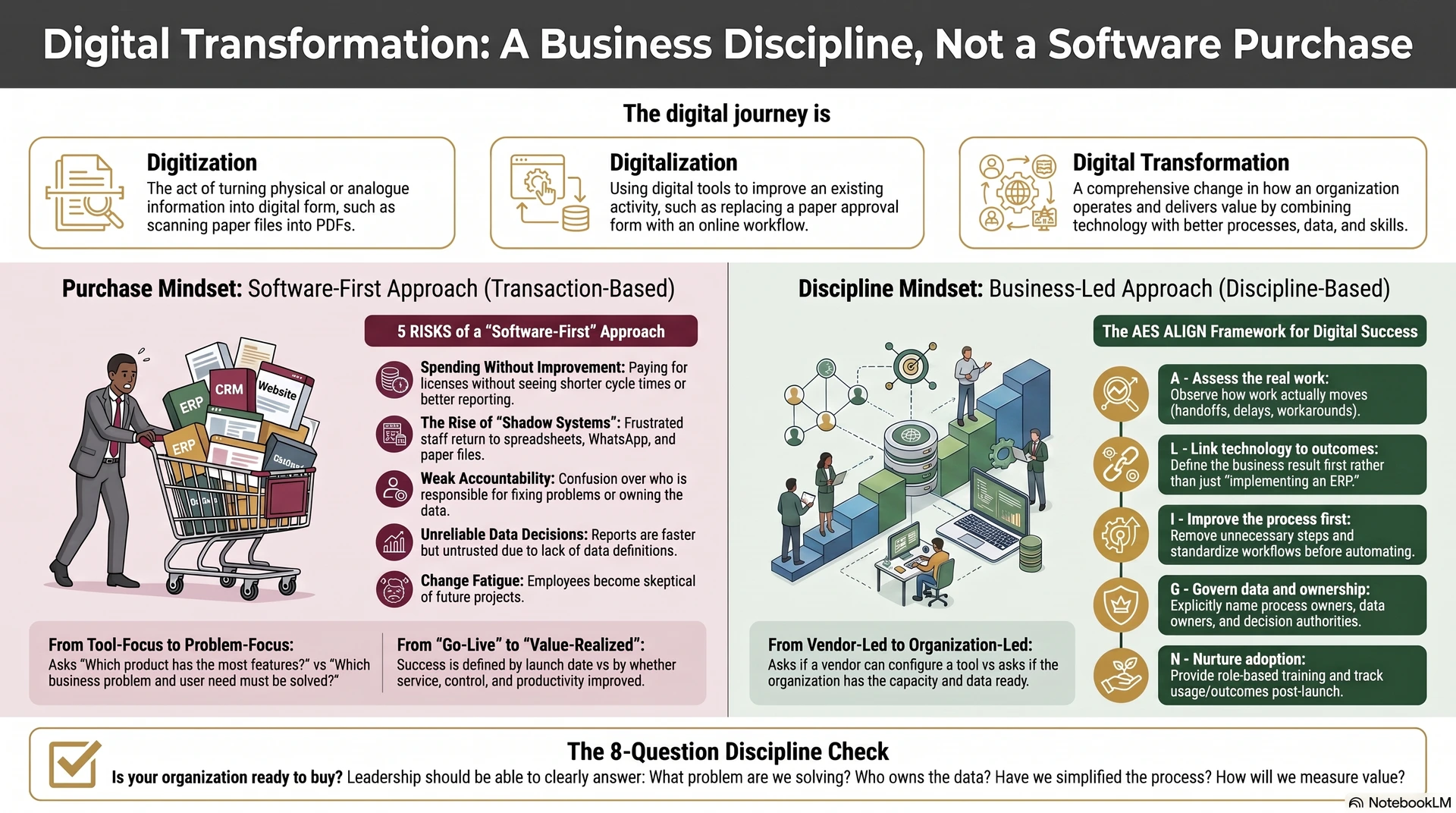
Digital transformation | Changing how the organization operates, makes decisions and delivers value by combining technology with better processes, data, governance and skills. |
The United Nations Development Program makes the distinction clearly: digital transformation is not merely about technology; it also involves strategy, new ways of thinking and working, and people’s inclusion in the change process. [1]
The difference between buying technology and transforming a business
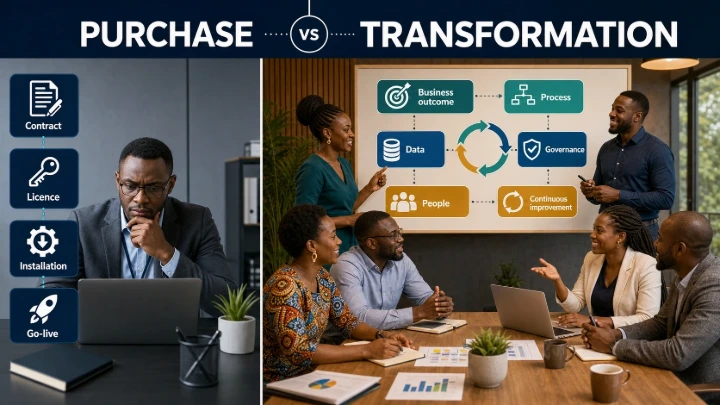
A software purchase is a transaction. The organization selects a tool, signs a contract, configures features and pays for licenses, implementation or support. Those activities may be necessary, but they do not automatically change how the organization performs.
Digital transformation is broader. It is the disciplined redesign of work, decisions, information and service using technology where it creates real value. It asks what should become faster, safer, clearer, more reliable or easier to manage—and then aligns processes, data, roles, controls, skills and tools around that result.
This distinction matters in African businesses and institutions because access to technology does not guarantee productive use. World Bank and IFC research across six African countries found that 86 percent of firms with five or more workers had access to at least one digital enabler, yet 23 percent did not use digital technologies for productive business tasks and 39 percent did not use them intensively. Only 11 percent made intensive use of advanced digital technologies for general business functions.[2] The data is not Zambia-specific, but it illustrates the wider regional gap between having technology and using it as part of the operating model.
A software-purchase question | A transformation-discipline question |
|---|---|
Which product has the most features? | Which business problem and user need must be solved? |
How quickly can we go live? | What process, data and ownership issues must be resolved first? |
How much is the license? | What is the total cost of implementation, adoption, support and improvement? |
Can the vendor configure it? | Can the organization make the decisions and provide the capacity the project requires? |
Did the system launch? | Did service, control, productivity, visibility or risk actually improve? |
Why the software-first approach creates business risk
When a new tool is placed on top of an unclear operating model, the organization does not remove confusion. It digitizes it.
The visible result is usually frustration: “The system does not work.” The deeper problem may be that the organization never made the decisions the system needed.
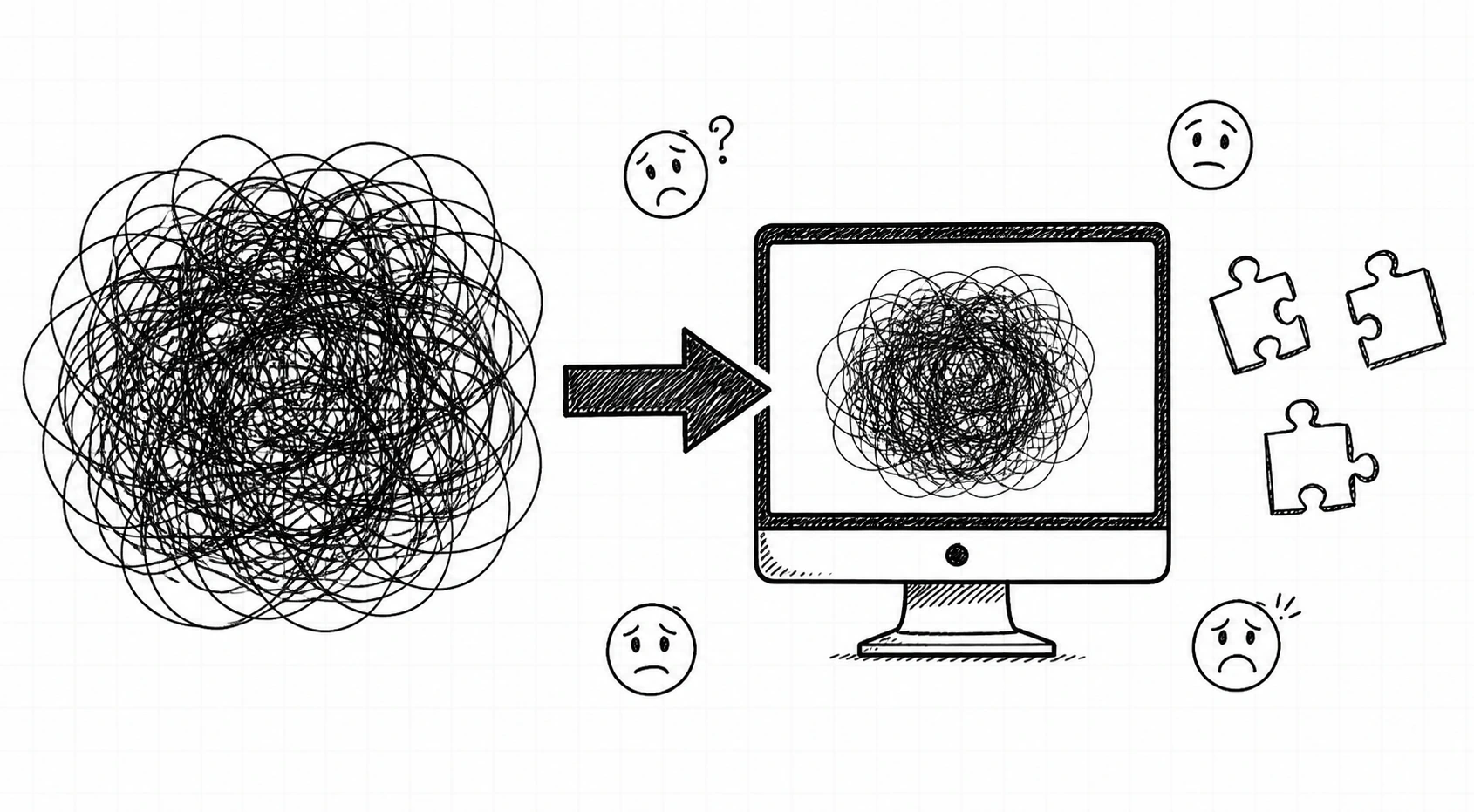
This creates five practical risks:
Spending on Technology without measurable improvement. The organization pays for licenses, configuration and support but cannot show shorter cycle times, better service, lower risk or stronger reporting.
Shadow systems. Staff return to spreadsheets, personal devices, paper files and messaging apps because the official tool does not match how work actually happens.
Weak accountability. Nobody is sure whether the process owner, IT team, vendor or department manager is responsible for fixing problems.
Poor data and decisions. Reports become faster to produce but remain unreliable because definitions, ownership and data-entry discipline were never established.
Change fatigue. Employees become skeptical of future projects because previous launches created more work without solving the original problem.
Research from the World Bank reinforces this point. Firm capabilities—including digital skills and management practices—are complementary to technology adoption, and training and advisory support can help organizations use technology more intensively and effectively.[3] In other words, a capable organization extracts more value from the same tool than an undisciplined organization.
Why the procurement mindset underperforms
When technology is treated as the entire solution, the organization quietly asks the tool to perform work that software cannot do. It asks the platform to settle disagreements between departments, correct undefined processes, decide who owns data, create management discipline, repair weak controls and persuade employees to change their habits.

The result is not always a dramatic project failure. Often it is partial adoption: the system is technically available, but important work still happens in parallel spreadsheets, paper files, personal inboxes or messaging groups. Reports are faster but not trusted. Staff complete extra steps to satisfy both the old and new process. Leaders see more dashboards but still struggle to make decisions.
This is incomplete transformation. The organization has added technology without changing the conditions that determine whether the technology can create value.
What the gap costs the organization
The cost is not limited to the purchase price. Weak transformation discipline creates business consequences that spread across departments:
Duplicated work when staff maintain the official system and private backup trackers at the same time.
Unreliable reporting when departments use different definitions, codes or sources of truth.
Slow decisions when the system exposes unresolved authority and approval questions.
Weak controls when access rights, exceptions and accountability are configured without clear governance.
Change fatigue when employees experience repeated launches that add effort without solving the original problem.
Technology debt when more tools are added to compensate for poor integration, weak processes or low adoption.
The problem may then be misdiagnosed as a need for another system. The organization spends again, while the same management weaknesses follow the new tool.
The AES ALIGN framework: five disciplines before and after the purchase
A useful way to approach digital transformation is to treat it as a repeating management discipline. The AES ALIGN Framework is an evidence-informed management discipline for ensuring that digital investments improve real work, deliver measurable outcomes, strengthen governance and achieve sustained adoption.
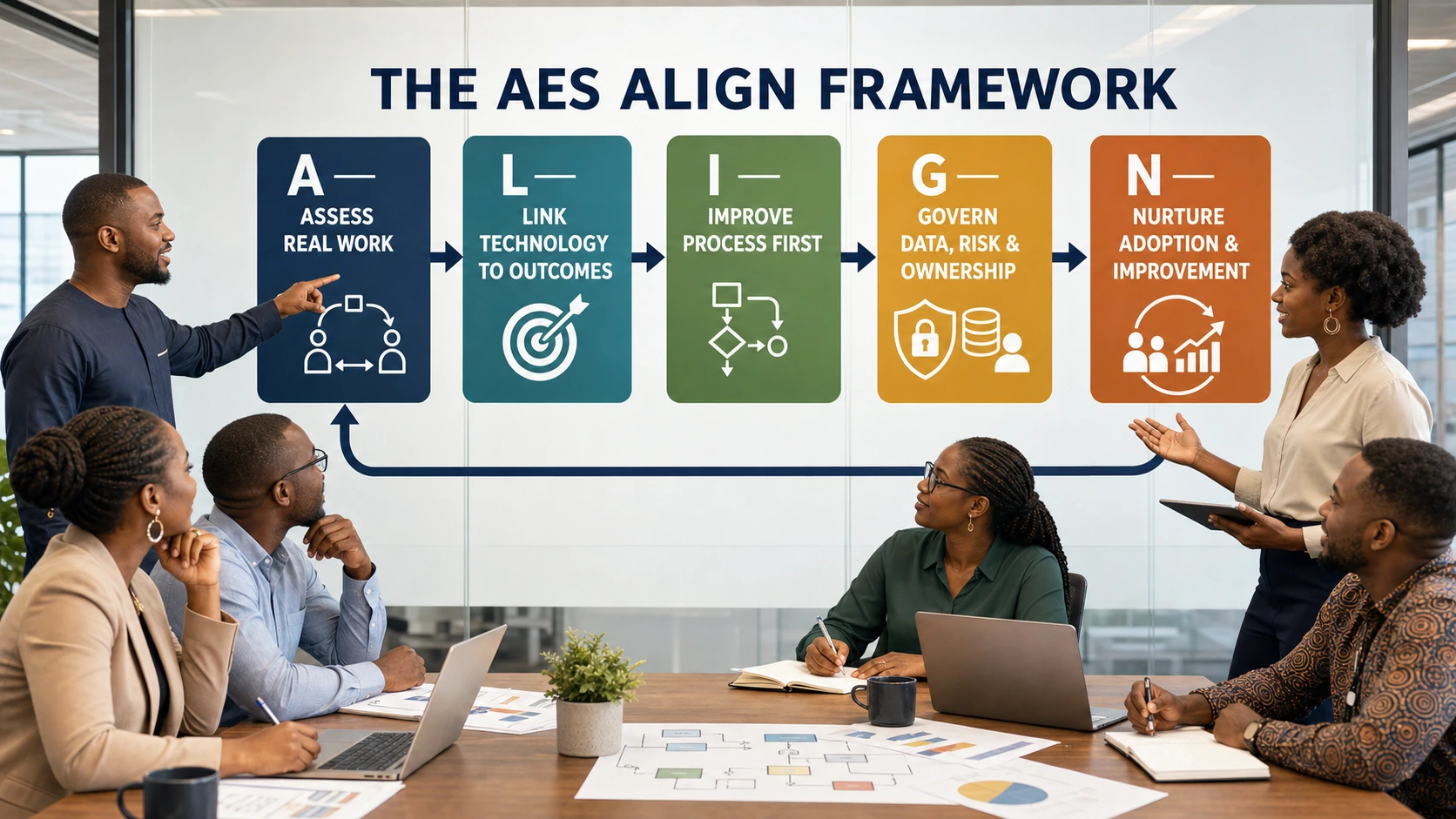
A — Assess the real work Observe how work actually moves today: requests, handoffs, approvals, exceptions, records, delays and workarounds. Do not design from the policy manual alone. | L — Link technology to outcomes Define the business result first: faster service, fewer errors, stronger controls, better reporting, reduced risk or improved customer experience. |
I — Improve the process first Remove unnecessary steps, clarify decision rights and standardize the workflow before automating it. Technology should support a better process—not preserve a broken one. | G — Govern data, risk and ownership Name the process owner, data owner, system owner and decision authority. Set access rules, quality standards, backup expectations and review routines. |
N — Nurture adoption and improvement Train people using real tasks, support the transition, track usage and outcomes, and improve the system after go-live. Adoption is managed, not assumed. |
A — Assess the real work
Start with observation, not assumptions. Follow one transaction from beginning to end. Watch where staff wait, re-enter information, ask for clarification or create personal workarounds. These points reveal the real transformation opportunity.
A school may think it needs a new student management system when the immediate problem is inconsistent data capture across departments. An NGO may think it needs a dashboard when programme and finance teams do not use the same definitions. A growing SME may think it needs automation when managers have not agreed who can approve what.
L — Link technology to a business outcome
Every digital initiative should answer a simple question: what must become measurably better?
“Implement an ERP” is an activity. “Reduce the time required to close monthly accounts and improve stock visibility” is an outcome. “Move files to the cloud” is an activity. “Give authorized staff secure access to the latest documents from any approved location” is an outcome.
Clear outcomes guide system requirements, budget decisions, training priorities and success measures. They also help leaders reject features that look impressive but do not solve the priority problem.
I — Improve the process before automating it
Automation is powerful because it repeats a process quickly and consistently. That is also why automating a bad process is dangerous: the organization can produce errors faster and at a larger scale.
Before configuration begins, simplify the workflow. Remove approvals that add no control. Define how exceptions will be handled. Agree the minimum information required at each stage. Decide where a human judgment is still necessary.
The goal is not to make every process fully automated. The goal is to use technology where it reduces avoidable work while preserving appropriate oversight.
G — Govern data, risk and ownership
Transformation becomes sustainable when ownership is explicit.
The business process owner should define what good performance looks like. IT should protect the architecture, integration, security and support model. Department leaders should enforce the new workflow. Data owners should define quality and access rules. Senior leadership should resolve cross-functional conflicts.
Zambia’s National Digital Transformation Strategy 2023–2027 similarly approaches transformation as a coordinated agenda built around digital infrastructure, literacy and skills, innovation and entrepreneurship, platforms and services, supported by digital government, policy and regulation, and security and integrity. [4]
N — Nurture adoption, measurement and continuous improvement
Go-live is not the finish line. It is the beginning of real use.
Employees need role-based training using their actual work, not only a generic demonstration. Managers need to stop accepting off-system shortcuts once the new process is stable. IT needs a support and issue-resolution routine. Leaders need to review adoption and business outcomes, not just system availability.
The OECD’s 2024 Digital Economy Outlook notes that effective use of digital technologies and data requires a broad range of skills that must be acquired, maintained and upgraded.[5] Training should therefore be ongoing and connected to changing work—not treated as a one-day launch event.

Useful measures may include cycle time, error rates, time spent reconciling data, percentage of work completed through the agreed workflow, report preparation time, user confidence, control exceptions, service response time and unresolved support issues. The right measures depend on the process; the discipline is to decide them before launch and review them after real use begins.
UNDP’s Digital Transformation Framework reinforces the need for coordinated progress across people, connectivity, government, regulation and the economy, supported by digital inclusion and appropriate digital public infrastructure. Its broader lesson for organizations is that technology, capabilities, governance, infrastructure and user inclusion must work together. [6]
Common mistakes that make technology look like transformation
Buying before defining requirements. The organization lets a product define the problem and requirements.
Making digital transformation an IT-only project. IT can lead technical delivery, but it cannot redesign finance, HR, procurement, program or customer-service decisions without business ownership.
Migrating every old record and rule. Historical clutter and outdated practices are transferred into the new environment without challenge.
Treating communication as change management. Sending an announcement or running one demonstration does not create competence, confidence or accountability.
Buying too much at once. The organization attempts an enterprise-wide transformation without enough capacity to design, test and support it.
Celebrating launch instead of results. The project is declared successful because it went live, even when performance and user behavior remain unchanged.
What each group should do
Group | Primary responsibility |
|---|---|
Board / executives | Define value, approve priorities and trade-offs, sponsor cross-functional decisions, review risk, protect time for process redesign and training, remove conflicting incentives, hold the transformation accountable for business outcomes and review whether performance improves. |
Business and process owners | Map real work, simplify the future process, define controls and exceptions, provide requirements and own performance after implementation. |
IT and digital teams | Translate needs into secure, supportable requirements; manage integration, data risk, vendors, testing and technical continuity; challenge unnecessary complexity and explain trade-offs in business language. |
Managers | Prepare teams, allocate time for testing and training, reinforce the agreed workflow, stop unnecessary parallel processes and escalate issues early. |
Staff and End users | Explain how work actually happens, test scenarios, learn the new workflow, report problems and avoid creating hidden workarounds that weaken data and control. |
An eight-question discipline check before the next purchase
Before approving another major platform, automation or system expansion, leadership should answer these questions clearly:
What specific business problem and user need are we solving, and what measurable result should improve?
Have we observed how the current work actually happens and simplified the current process, including exceptions and informal workarounds?
Who owns the process, the data, the technology, the risk and the final business outcome?
Which steps should be removed, standardized or redesigned before automation?
Are the data definitions, quality, migration and reporting requirements ready?
What integration, security, privacy, continuity and vendor dependencies must be managed?
How will each user group participate, learn, receive support and be held accountable for the agreed workflow?
Which measures and review dates will prove whether the change is delivering value?
If several answers are unclear, the organization may not be ready to buy. It may first need a process review, digital strategy workshop, data assessment or transformation roadmap.
The bottom line
Digital transformation is not defined by the amount of technology an organization owns. It is defined by the capability the organization builds.
Two organizations can buy the same system. One improves service, visibility and control because it redesigned the work, clarified ownership, prepared its data and supported its people. The other creates a more expensive version of the same confusion because it treated the tool as the transformation.
The better first question is not, “Which software should we purchase?” It is, “What must change in our strategy, process, data, governance and people so that technology can produce a better business result?”
When that change exists, software becomes a strong enabler. Without it, the organization may go digital without becoming better.

A practical next step with AES
Use the AES Digital Strategy Canvas and the Digital Maturity Assessment to define the business problem based on your industry, intended outcome, process, data, governance, adoption needs and measures of success before selecting or expanding a system.
AES Digital Strategy Canvas Completed Example v1.0.pdf
AES Digital Maturity Assessment Completed Example v1.0.pdf
AscendEdge Solutions can support a digital readiness review, strategy roadmap, process-technology alignment, requirements definition, implementation oversight and team adoption—starting with the business reality rather than the product
Share ArticleExplore AES IT & Digital Transformation | Request a consultation
"Do not ask “Which tool should we buy?” until the canvas can explain the problem, outcome, process, data, ownership, adoption needs and measures of success in plain language."
Related Articles
Why Growing Businesses Become Inefficient — and Don’t Notice (In Business Today)
Why Many Digital Projects Fail Before Implementation Starts (Digital & IT Insights)