
Manual processes quietly consume time, delay decisions and create rework. Learn the six hidden charges, how to estimate the cost and what to improve before automating.
It is exactly 4:35 on a Thursday late afternoon, a customer calls to ask why an invoice has not arrived.
Sales says the order details were sent to Finance on WhatsApp. Finance says the delivery note is missing a signature. Operations says the signed copy is in a vehicle that has already left for another delivery. A manager joins the discussion because nobody is sure whether the invoice can be raised without the original document.
By the time the issue is resolved, four people have searched messages, checked spreadsheets, made calls and repeated information that already existed somewhere in the business. The invoice goes out late. Everyone returns to work. No one records how much time the process consumed.
This is how the hidden tax of manual processes is paid: not through one dramatic expense, but through hundreds of small interruptions that appear normal because the work eventually gets done.
Manual work is not automatically bad.
A small organization may reasonably use a spreadsheet, paper form or human approval for a low-volume task. Some work requires judgement, conversation or physical verification. The problem begins when a recurring, high-volume or business-critical process depends on retyping, chasing, remembering, printing, signing, scanning and checking by hand.
At that point, 'manual' stops describing a method and starts describing a cost structure.
Why the cost is easy to miss
The “hidden tax” means the extra, often unnoticed cost a business pays because of inefficient manual processes. It is not a government related tax. For example, a business may rely on spreadsheets, paper forms, WhatsApp messages, repeated data entry, manual approvals, or one employee who knows how everything works.
Most leaders can see the cost of a new employee, a software subscription or a delivery vehicle. Manual-process costs are harder to see because they are spread across existing salaries, delays, corrections, phone calls, meetings and customer frustration.

A task that takes ten minutes feels too small to investigate. Yet if it happens several times a day, involves several people and triggers occasional rework, the annual cost can become significant. The organization rarely receives an invoice labelled 'unnecessary follow-up' or 'time spent searching for the latest version.' It simply experiences full calendars, slow turnaround and repeated requests for more staff.
Employees also protect the process from being exposed. They create private trackers, remember missing steps, call colleagues for updates and stay late to finish work. Their effort keeps the organization moving, but it can make a weak process look healthier than it is.
The six charges on the manual-process bill
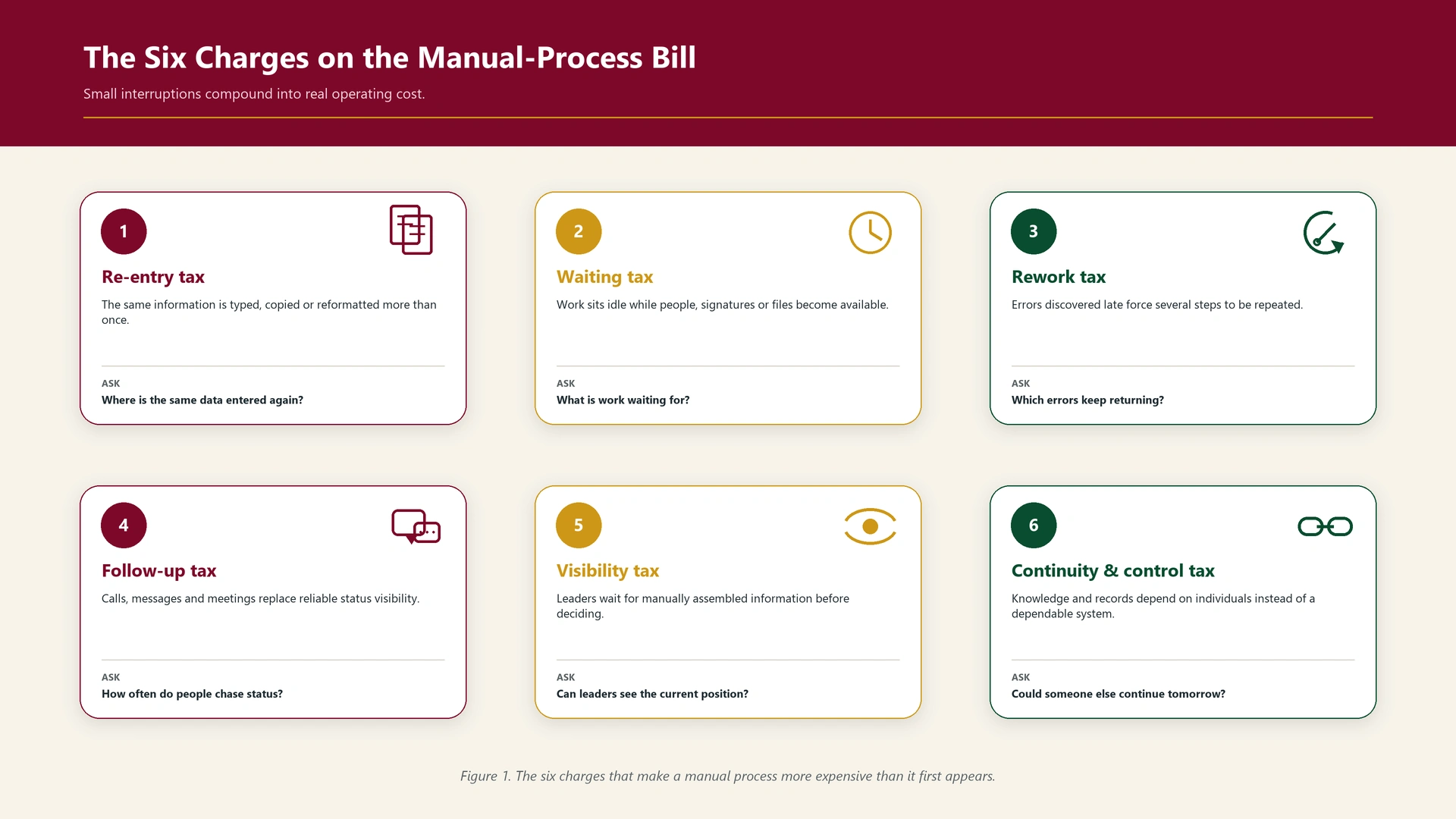
1. The re-entry tax
The same information is entered more than once because systems, forms or departments do not share a reliable record. A customer name may begin in a WhatsApp message, move to a spreadsheet, appear again on an invoice and then be typed into a report. Every re-entry takes time and creates another opportunity for a spelling, quantity, date or account error.
Ask: How many times is the same information typed, copied or reformatted before the process is complete?
2. The waiting tax
Manual processes often move at the speed of availability. A request waits for a signature, a manager returns from a meeting, a paper file reaches another office or someone finds the correct message. The work may require only five minutes of activity but take two days to complete because most of its life is spent waiting between steps.
Ask: Where does work sit still, and what exactly is it waiting for?
3. The rework tax
Errors discovered late are expensive because several downstream steps may already have been completed. An incorrect quantity can affect an invoice, stock record, delivery plan and customer communication. The visible correction may take fifteen minutes; the full repair may involve several people reversing, explaining and checking the same transaction.
Ask: Which mistakes keep returning, and how far through the process are they usually discovered?
4. The follow-up tax
When status is not visible, people create visibility through calls, messages, emails and meetings.
'Has this been approved?'
'Who has the file?'
'Which version is final?'
Each question may feel routine, but together they consume management attention and interrupt productive work.
Ask: How many conversations exist only to locate information or confirm progress?
5. The visibility tax
Leaders make poorer or slower decisions when operational information must be assembled manually. By the time figures are reconciled, the situation may have changed. Managers then rely on partial updates, personal experience or whoever speaks most confidently instead of a timely view of what is happening.
Ask: Can management see the current position without asking several people to compile it?
6. The continuity and control tax
Manual records are often scattered across notebooks, inboxes, devices, desks and individual memory. This makes handover difficult, weakens audit trails and increases dependence on key employees. The risk becomes visible when someone is absent, a device is lost, a customer disputes what was agreed or an organization needs evidence quickly.
Ask: If the process owner were unavailable tomorrow, could another capable person continue the work confidently?
How the tax spreads through the business
The direct time spent on a manual task is only the first layer. The process also affects the parts of the organization that depend on its output. A delayed delivery note can postpone an invoice. A late invoice can delay collection. Missing or inconsistent information can slow a management decision. A customer may experience all of this as poor service even though the underlying problem began with an internal handover.
The people cost is equally important. Capable employees become frustrated when they repeatedly solve problems that should have been prevented. Experienced staff are pulled into routine checking because leaders trust them to rescue the work. New employees take longer to become effective because the real process is learned through observation and informal correction rather than a dependable method.

There is also a management-quality cost. When information arrives late or in conflicting versions, leaders spend more time confirming the facts and less time deciding what to do. Meetings become status-recovery exercises. Managers learn to keep private records because they do not trust the shared process. The organization may appear to have a communication problem when the deeper issue is that the workflow produces uncertainty.
Finally, manual friction limits growth. If every increase in customers, transactions, students, beneficiaries, projects or branches requires a similar increase in administrative effort, the organization is scaling labour rather than capability. Growth becomes more expensive because the old process must be carried by more people.
A simple way to calculate the hidden cost
Start with one recurring process rather than trying to calculate the cost of every manual task in the organization.
For the direct handling time, multiply the number of people involved by the minutes each person spends per occurrence, then multiply by how often the process occurs. Convert the result into annual hours and apply the organization’s own internal hourly cost. This gives a starting estimate, not the full cost.
For illustration, if three people each spend twenty minutes every working day reconciling the same information, the process consumes about 264 staff hours a year, using twenty-two working days per month. That figure does not yet include waiting time, mistakes, customer follow-up, delayed invoicing or management intervention.
The point is not to make every minute look expensive. It is to stop treating repeated manual effort as free.
Cost component | What to measure |
|---|---|
Direct handling | People involved X minutes per occurrence X frequency. |
Waiting | Elapsed time between steps, approvals or handovers. |
Rework | Corrections, reversals, duplicate entries and repeated checks. |
Follow-up | Calls, messages, emails and meetings used to locate status or information. |
Delay impact | Late invoices, delayed service, missed deadlines or postponed decisions. |
Control and continuity | Missing evidence, weak handovers, key-person dependency and record risk. |
A practical diagnostic for leaders
Diagnostic question | What a concerning answer may reveal |
|---|---|
How many times is the same information entered or copied? | Disconnected records and avoidable error exposure. |
Which step cannot move until a particular person is available? | Centralized approval or key-person dependency. |
How often do staff call or message simply to find the status of work? | Weak process visibility. |
Where are errors normally discovered? | Late-stage quality control and expensive rework. |
Can a reliable operational report be produced without manual consolidation? | Fragmented information and slow decision support. |
What happens when the main process owner is absent? | Poor documentation, weak handover or continuity risk. |
Are skilled employees spending significant time on repetitive administration? | High-value capacity is being consumed by low-value work. |
Could transaction volume double without staff effort doubling as well? | The process may not be ready to scale. |
Several concerning answers may indicate that the issue is structural rather than an isolated staff-performance problem.
The leadership insight: manual work becomes strategic when it shapes flow
Leaders often view manual processes as administrative details. But once those processes influence cash flow, customer service, reporting, compliance evidence, staff capacity or decision speed, they are no longer administrative details. They are part of the operating model.
The leadership task is not to remove every human step. It is to distinguish where human judgement adds value from where people are merely carrying information between disconnected steps.
A useful question is: Are we paying capable people to think, decide and serve - or to search, copy, chase and correct?
The hidden tax is not only the time already spent. It is the more valuable work the organization cannot do because its people are busy keeping the process together.

Manual is not the enemy - unmanaged repetition is
A useful process review should not begin with the assumption that everything must become digital. Some manual steps are sensible because the volume is low, the situation changes frequently or professional judgement is essential. A site inspection, sensitive approval, quality check or relationship conversation may need human attention.
The better question is whether the manual step adds judgement, assurance or customer value. If it only transfers information from one place to another, waits for a predictable approval or repeats the same rule every time, it may be a candidate for simplification or automation.

This distinction protects the business from two expensive mistakes: keeping repetitive work manual simply because it is familiar, and automating work that was never understood well enough to redesign.
What successful improvement actually requires
Map the process as it really happens. Follow one transaction from beginning to end and include the unofficial calls, messages, private spreadsheets and rescue steps.
Remove unnecessary steps before adding technology. A digital version of a poor workflow is still a poor workflow.
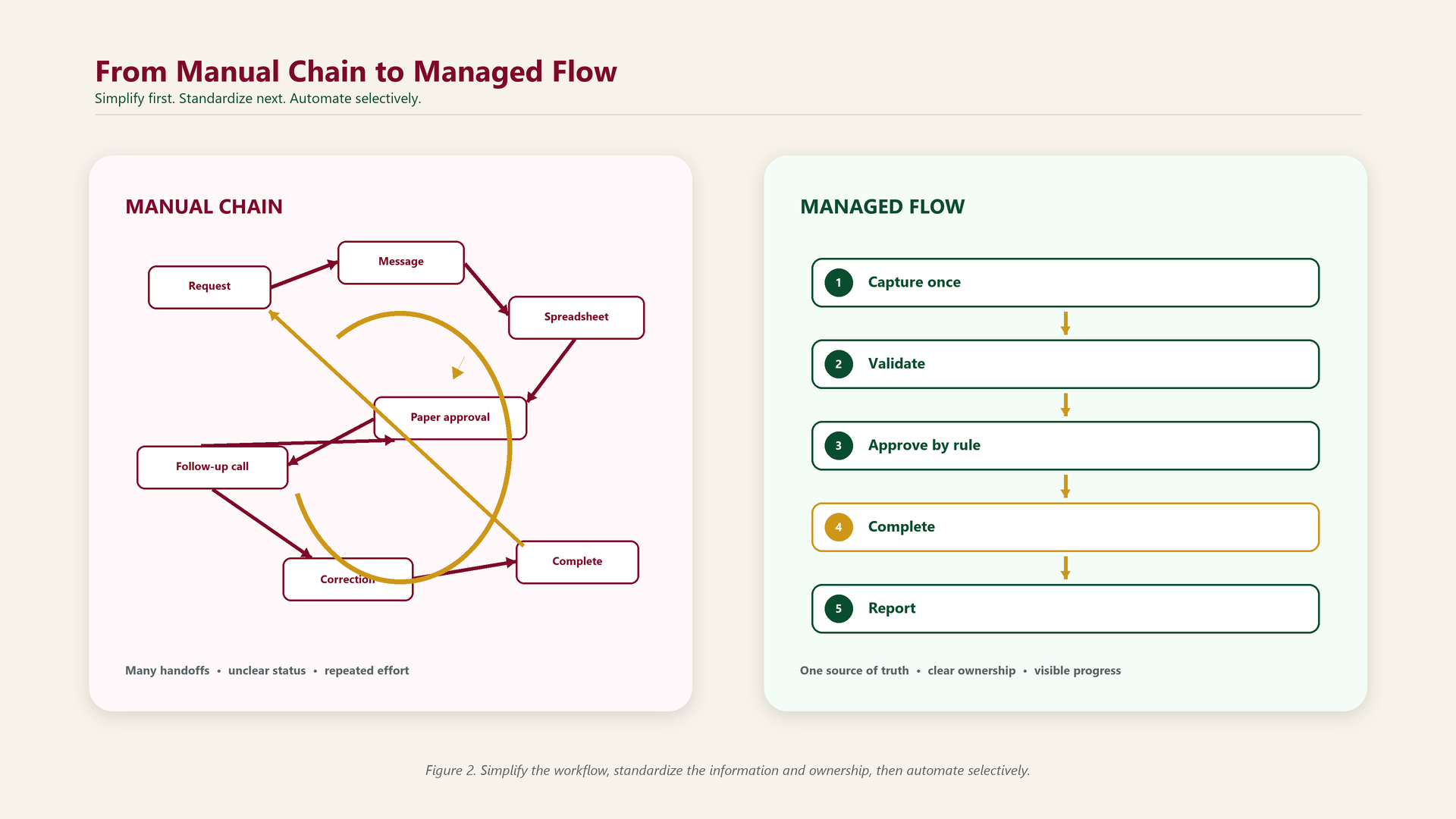
Standardize the information entering the process. Clear forms, required fields, naming rules and one accepted record reduce re-entry and confusion.
Clarify ownership and decision rights. People should know who owns the outcome, what they can approve and when an exception must be escalated.
Create one dependable source of truth. The people involved should work from the same current information rather than personal versions.
Automate the repeatable parts with the right level of control. Focus first on high-volume, rules-based work where delay and re-entry create real cost.
Pilot, train and measure. Test the improved workflow with the people who use it, track turnaround, errors and follow-up, then adjust before expanding.
What leaders should avoid
Common reaction | Why it often underperforms | Better question |
|---|---|---|
Buy software before mapping the work | The organization may digitize unnecessary steps or create another disconnected system. | What exact workflow, decision or visibility problem must the tool solve? |
Automate every manual activity | Some activities are low-volume or require judgement; automation may cost more than it saves. | Where is manual effort repetitive, high-volume and rules-based? |
Treat spreadsheets as the entire problem | A spreadsheet may be useful; the deeper issue may be ownership, version control or process design. | What risk comes from how the tool is used, shared and governed? |
Blame staff for slow work | People may be compensating for unclear handovers, approvals or missing information. | What in the process makes delay or error likely? |
Remove controls in the name of speed | Faster work can create financial, quality or compliance exposure if decision rules are weak. | Which controls add value, and which merely add waiting? |
Launch a large transformation at once | Too much change makes adoption difficult and hides whether a specific improvement worked. | Which one process offers the clearest customer, capacity or control benefit? |
A practical 30-day starting point
1. Choose one recurring process that causes frequent delay, rework or follow-up.
2. Observe and map what actually happens, including every manual handover and workaround.
3. Measure volume, handling time, waiting, corrections and the people involved.
4. Remove unnecessary steps and clarify the required outcome, owner and decision rights.
5. Decide what should remain human, what should be standardized and what is suitable for digital support.
6. Pilot the improved process with a small group, train the users and capture feedback.
7. Compare turnaround, errors, follow-up and visibility before and after the change.
One well-improved process can release capacity, improve service and teach the organization how to approach the next problem. Sustainable process improvement is usually built through a sequence of focused changes, not one dramatic system purchase.
AES Perspective
At AscendEdge Solutions, we start with how work actually happens - not with a software wish list. A practical review examines the very things that lie under the table, things like the workflow, handovers, information sources, decision rights, controls, people involved and the cost of current workarounds before recommending process redesign or technology.

The right response may include simplifying the workflow, creating practical documentation, clarifying accountability, improving reporting, introducing a suitable digital tool or training the team to work differently. The solution depends on the organization’s size, transaction volume, risk, budget and stage of growth.

What to do Next
Use our Manual Process Cost Calculator to estimate where time, rework, delay and follow-up are consuming capacity. Organizations that need a deeper review can request an AES Operations and Process Diagnostic to map the current process, identify priorities and develop a practical improvement plan
Share Article
Explore AES Business Process Outsourcing | Request a consultation
Frequently asked questions
Here are some common questions about our company.

No. Manual work may be appropriate for low-volume, irregular or judgement-heavy activities. The concern is recurring, high-volume or critical work that depends on repeated entry, chasing, waiting and correction.
Begin with the people involved, minutes per occurrence and frequency. Convert this into annual hours, then add rework, follow-up, waiting, delay impact and continuity or control risks.
Not automatically. Remove unnecessary steps, clarify ownership and standardize the process first. Automate where volume, rules, risk and expected benefit justify the investment.
Yes. The risk depends on how the spreadsheet is controlled, shared, updated and integrated into the wider workflow. A well-managed spreadsheet can be useful; multiple uncontrolled versions can create confusion.
Start with a recurring process that creates visible customer delay, cash-flow impact, frequent rework, heavy management follow-up or significant key-person dependency.
Related Articles
Why Growing Businesses Become Inefficient — and Don’t Notice (In Business Today)
The Businesses That Scale Successfully Think in Systems, Not Effort (In Business Today)
What SMEs Should Digitize First: A Practical Decision Framework (Digital & IT Insights)